Get Full Government Meeting Transcripts, Videos, & Alerts Forever!
Get email alerts on the Telecom Siting topic
No spam. Unsubscribe anytime.
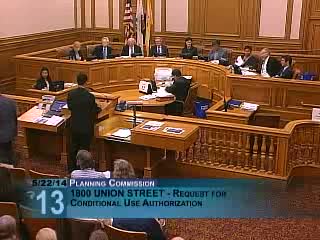
Planning Commission Approves AT&T Rooftop Upgrade at 1800 Union Despite Historic‑preservation Objections
Summary
AT&T won a conditional use permit to install six panel antennas screened by a penthouse expansion at 1800 Union Street to close a coverage gap; neighbors and historic groups argued the faux‑stack screening would harm the 1933 Art Deco building and Union Street character.
The Planning Commission approved a conditional use permit allowing AT&T to replace small façade micro‑antennas with up to six directional panel antennas at 1800 Union Street, mounting the equipment on a screened penthouse treatment that AT&T proposed to style as a set of vent‑like stacks. "Approval of this CUP will permit AT&T to place up to 6 directional panel antennas on the roof of the subject property," Teddi Verhais, AT&T’s director for external affairs, told the commission.
AT&T submitted a written alternative‑site analysis and a public‑health emissions review; city Department of Public Health staff determined projected RF emissions would comply with safety limits. Planning staff concluded that no higher‑preference public facility was available and recommended approval.
Neighbors, preservation groups and the Union Street Association urged denial. Robert Bardell of the Golden Gate Valley Neighborhood Association called 1800 Union "a beautiful example of Art Deco architecture" and said the proposed faux‑stacks would be a visible, ‘‘ungainly’’ addition. The Art Deco Society wrote in opposition, saying the installation would degrade a building they described as contributing to the Union Street streetscape.
Commissioners debated alternatives and asked AT&T whether upgrades under construction nearby could obviate the need for a prominent installation. AT&T said additional sites and upgrades in the corridor would not remove the coverage and capacity needs the proposed installation addresses; they also said some antennas being removed would reduce façade clutter. After deliberation and direction for staff to continue working with the applicant on the final design and screening details, the commission voted unanimously to approve the CUP.