Get Full Government Meeting Transcripts, Videos, & Alerts Forever!
Get email alerts on the Wireless Permits topic
No spam. Unsubscribe anytime.
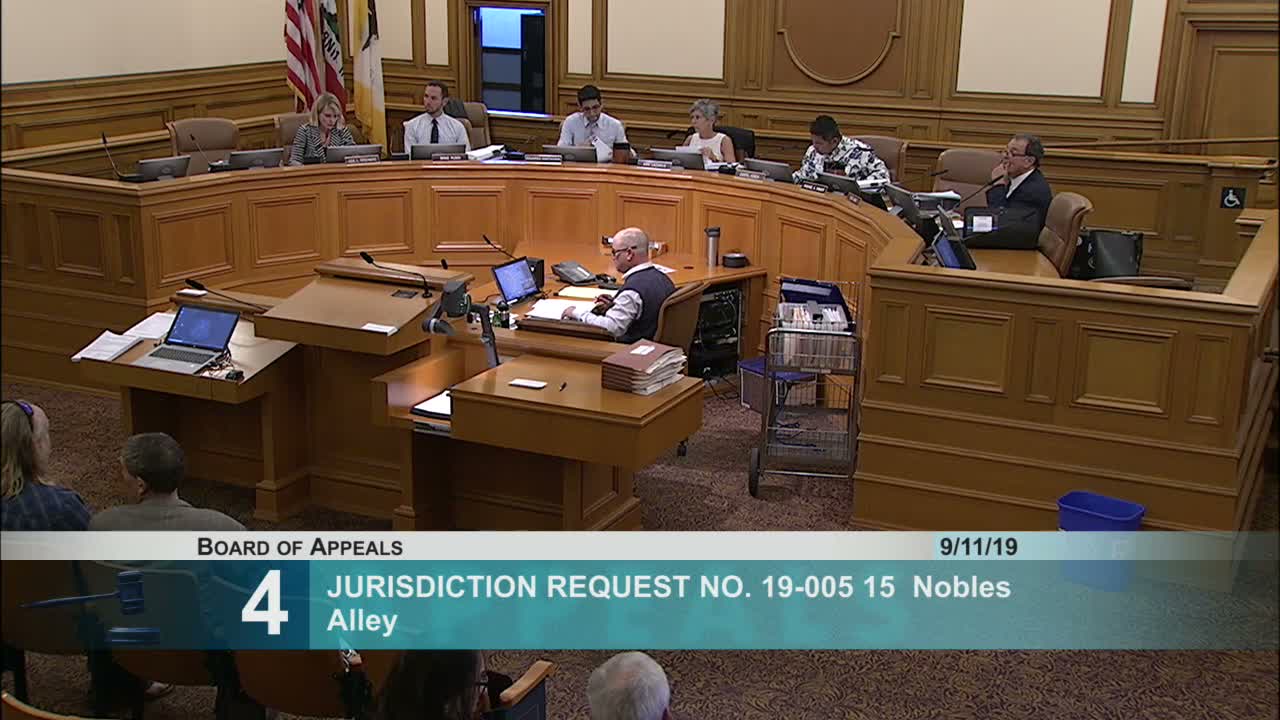
Board upholds DPW permit for Verizon node near Laguna Street home, residents secure conditions discussion
Summary
Appellant Daniel Kreps asked the Board of Appeals to require independent testing and an explicit bar on 5G; city and Verizon said the permit followed Article 25 review and post‑installation testing by DPH. The board denied the appeal amid discussion of state law changes and DPH review.
The San Francisco Board of Appeals denied an appeal on Sept. 11 by Daniel Kreps and other neighbors who had sought to block a personal wireless facility installed near their home at 2035 Laguna Street.
Kreps told the board he and his wife were not contesting the permit solely on radio‑frequency exposure but said the applicant’s technical submissions were inadequate and asked that the permit expressly bar any 5G operation without a new application and require an independent, Department of Public Health ambient study before approval. He also presented handheld meter readings and asked for post‑installation limits and a clear, enforceable cap on effective radiated power.
Outside counsel for Verizon Wireless, Paul Albertson, and an RF engineer for Hammitt/Hammond & Edison said the application met the city’s technical requirements and that the standard city process calls for DPH to review RF calculations and for post‑installation measurements when sites are active. Engineer Daniel Roe told the board the low‑cost consumer meters the appellants brought do not report exposure on the FCC standard scales and typically overstate risk; he said independent measurements at the site would likely show levels well below FCC limits.
Leo Palacios of Public Works explained that Article 25 requires referral to the Department of Public Health and the Planning Department and that modification to add 5G or increase power would require a new modification permit and further DPH review. The board discussed a recent state law change that affects which poles require a permit and whether the board should reach merits on older permits; members noted DPH has purchased professional meters and carried out some cumulative measurements in other neighborhoods.
The board concluded the permit had been issued following required agency referrals and denied the appeal. Board members said they expect DPH to continue to review RF issues and that any significant modification (including 5G operation) would trigger further city review. The board’s decision preserves the post‑installation testing requirement and the city’s ability to require additional DPH review for any future changes.
The board did not set an independent pre‑installation ambient testing requirement tonight; appellants said they would continue to press DPH for independent study and will use available administrative avenues to request further monitoring.
The matter was decided by majority vote; the board did not adopt new operational limits beyond the existing DPH/permit review process. The appeal was denied and the DPW determination upheld.
The Board of Appeals record shows the permit, DPW and DPH review materials remain available through city channels for any follow‑up monitoring or enforcement requests.