Get Full Government Meeting Transcripts, Videos, & Alerts Forever!
Get email alerts on the Land Use topic
No spam. Unsubscribe anytime.
Planning Commission splits on ordinance for Apple Union Square project; approves downtown authorization subject to Board action
Summary
The commission split 3–3 on a proposed code amendment tied to the Apple/300 Post Union Square project but later approved the Section 309 downtown project authorization by a 5–1 vote and the zoning administrator stated he would likely grant a transparency variance; the project drew intense public comment over CEQA, the Ruth Asawa fountain and public plaza design.
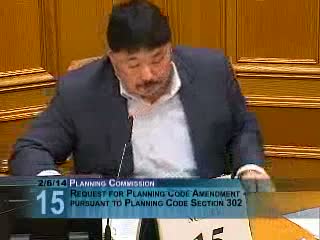
The Planning Commission on Feb. 6 heard a contested proposal to amend the Planning Code to allow partial demolition and reconstruction of a nonconforming "secondary structure" at 300 Post Street — the site of a proposed Apple flagship store and reconfigured plaza that would relocate the Ruth Asawa fountain.
Planning staff said the narrow code amendment was intended to apply to a single parcel and would require the commission to make findings under Planning Code Section 309 before allowing a qualifying project. Elizabeth Waddy, Planning Department staff, summarized the ordinance language and the design approvals needed for project review.
Project sponsor Apple described a design that reduces the height of the retail portion, reshapes the plaza and preserves the Ruth Asawa fountain at the center of a new set of stairs. Development director Rick Militello said the fountain "will be moved as one complete structure" and described the design as a "world class" flagship for the district.
Public reaction was divided. Supporters including the Union Square Business Improvement District and the Hotel Council praised the project for bringing foot traffic and investment to Union Square. Opponents, led in part by SEIU and neighborhood critics, urged a fuller environmental review and said the project would diminish the historic public plaza. Richard Drury of SEIU argued staff could not rely on a CEQA exemption because the project "clearly will relocate the Azawa Fountain and will change the immediate surroundings of the Azawa Fountain." Several speakers said the current process had proceeded piecemeal and asked that CEQA review be reconsidered.
On the commission floor, a motion to recommend approval of the Planning Code text amendment (the ordinance that would enable the demolition/reconstruction provision) failed on a 3–3 vote, with Commissioners Moore, Sugaya and Wu opposed. Later, the commission voted on the downtown project authorization (Section 309 design review) and adopted it with conditions by a 5–1 vote; staff and the city attorney noted the Section 309 approval would be conditional on the Board of Supervisors ultimately approving the code amendment required for demolition/reconstruction.
Commissioners added conditions asking staff and the applicant to work with the Mayor’s Office on Disability on plaza accessibility and to provide a conservation assessment and treatment plan for the Ruth Asawa fountain before any move or dismantling occurs. Deputy City Attorney Susan Cleveland Knowles said motions are unusual but valid: the Section 309 findings can be made conditionally, but the project cannot be implemented until the Board of Supervisors acts on the ordinance.
Outcome and next steps: text amendment failed to get a commission recommendation (3–3 tie) and will proceed to the Board of Supervisors without a favorable planning-commission recommendation; the commission approved the Section 309 downtown project authorization 5–1 with added conditions; the zoning administrator indicated he was inclined to grant the requested transparency variance for the project’s street frontage.