Get Full Government Meeting Transcripts, Videos, & Alerts Forever!
Get email alerts on the Economic Development topic
No spam. Unsubscribe anytime.
City staff propose zoning changes to boost space for manufacturing and PDR businesses
Summary
Planning staff unveiled amendments to the Planning Code intended to create more production, distribution and repair (PDR) space by allowing development on qualifying large vacant parcels if at least 33% of new buildings are reserved for PDR, and by easing approval pathways for certain food-and-beverage and small enterprise workspaces.
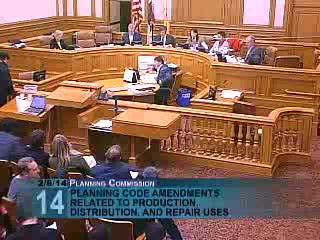
Planning Department staff and several supervisors’ offices presented a package of proposed Planning Code amendments on Feb. 6 aimed at expanding space for production, distribution and repair (PDR) businesses in the Eastern Neighborhoods and Central Waterfront.
John Lau of the Office of Economic and Workforce Development said the proposal seeks to "provide more space for light industrial businesses in San Francisco for today and for tomorrow," framing the amendments as a response to growing local manufacturing demand. Staff explained the core proposal would allow development on large vacant PDR‑zoned parcels north of 20th Street with a floor‑area ratio and parcel-size threshold if the new building dedicates at least 33 percent of its floor area to PDR uses and provides a detailed PDR business plan and performance measures.
Staff and supervisors' aides said the change is designed to create more long-term, entry-level jobs and to enable cross‑subsidized development where a higher-rent use (for example, office) helps fund space that would otherwise be uneconomic for manufacturers. The package also includes changes to facilitate small enterprise workspace, allow PDR accessory retail and let some food- and beverage-related PDR uses be permitted as-of-right to reduce permitting delays for brewers and similar businesses.
Support came from industry groups: Kate Sophos, executive director of SFMADE, said local manufacturers are adding jobs but that the "lack of being able to find industrial space is now the number 1 threat to the continued growth of this sector." Business and workforce representatives urged the commission to keep public benefits and accountability — several speakers and the Council of Community Housing Organizations asked for enforceable long-term affordability and monitoring of PDR rent levels.
Opponents and some neighborhood speakers raised concerns that the policy could open the door to increased office development and displace smaller PDR tenants; several commissioners asked for parcel maps, estimates of net PDR square footage per candidate parcel and clearer enforcement tools to ensure PDR space remains affordable and viable.
Next steps: staff said they will return with more detailed maps and draft ordinance language, and that several elements remain under review with the city attorney and community advisory committees before the item returns for formal action.