Get Full Government Meeting Transcripts, Videos, & Alerts Forever!
Get email alerts on the Environment Ceqa topic
No spam. Unsubscribe anytime.
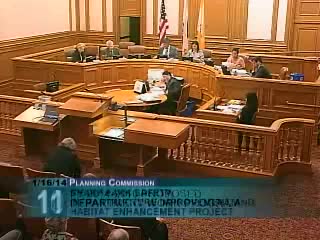
Planning Commission upholds Sharp Park mitigated negative declaration after contentious public debate
Summary
The Planning Commission voted unanimously to uphold the Planning Department's Preliminary Mitigated Negative Declaration for the Sharp Park Safety Infrastructure Improvement and Habitat Enhancement Project after hours of testimony from conservation groups, scientists and golf-course advocates.
SAN FRANCISCO ' The San Francisco Planning Commission on Jan. 16 voted 5-0 to uphold the Planning Department's Preliminary Mitigated Negative Declaration (PMND) for the Sharp Park Safety Infrastructure Improvement and Habitat Enhancement Project, rejecting an appeal that had sought a full Environmental Impact Report.
The item drew more than two hours of public testimony. Brent Plater, executive director of the Wild Equity Institute, urged the commission to order a full EIR, arguing the project's sediment removal and vegetation clearing around Horse Stable Pond and the connecting channel would increase pump-driven water removal and threaten breeding habitat for the California red-legged frog and the San Francisco garter snake. "When those pumps are turned on and start removing close to 10,000 gallons of water per minute from the system," Plater said, "the egg masses dry out and they die." He also noted that the U.S. Fish and Wildlife Service biological opinion the city cites is the subject of litigation and questioned whether the opinion properly applies to the Rec & Park project.
Lisa Wayne, Open Space Manager for the San Francisco Recreation and Park Department, replied that the project is designed with strict pumping protocols and other conservation measures. Wayne said staff's goal is to restore and maintain open water habitat and cited monitoring and mitigation commitments included in the biological opinion and the project's Mitigation, Monitoring and Reporting Program. She told the commission the department would adjust pumps to protect egg masses even if that required temporarily flooding portions of the golf course.
The project before the commission includes five elements: construction of a perennial pond of about 1,600 square feet; realignment of a section of golf cart path; removal of sediment and emergent vegetation in Horse Stable Pond and the connecting channel; construction of a 4.6-foot-wide maintenance walkway; and replacement of a wooden retaining wall with concrete at the pump house. Staff said the measures aim to restore habitat for the California red-legged frog and the San Francisco garter snake and to protect pump infrastructure.
Supporters of the PMND included the San Francisco Public Golf Alliance, local golfers and other community members who described Sharp Park as a historic, accessible public golf course and argued the project's conservation measures and interagency permitting process would protect sensitive species. Opponents included conservation scientists and Wild Equity's hydrology consultant, who told commissioners that expert disagreement about hydrology and cumulative impacts typically triggers the need for a full EIR under CEQA.
Planning staff recommended the PMND be upheld, saying the document properly analyzes the project's environmental effects, that mitigation measure M Bio 2B (soil testing and toxic-pathway analysis) is enforceable and not deferred, and that ongoing pump operations are treated as baseline conditions under CEQA. In response to testimony, staff pointed to Exhibit A in the appeal packet, which addresses the appellants' technical and legal concerns.
After deliberation, commissioners said the PMND was adequate for the project as framed and noted that additional permits and agency reviews (including U.S. Army Corps of Engineers, California Coastal Commission and the Regional Water Quality Control Board) remain part of the process. The commission's motion to uphold and finalize the PMND passed unanimously.
What happens next: staff and the Recreation and Park Department will continue to pursue required permits from other agencies; the PMND decision means the Planning Department does not prepare an EIR for this narrow project at this stage. Parties who raised substantive technical disagreements may rely on the record in subsequent review or litigation.
Sources: Planning Department staff presentation; public testimony from Brent Plater (Wild Equity Institute) and Lisa Wayne (San Francisco Recreation and Park Department).