Get Full Government Meeting Transcripts, Videos, & Alerts Forever!
Get email alerts on the Telecom Permitting topic
No spam. Unsubscribe anytime.
Board of Appeals continues contested Verizon permit at 2 Grattan Street to July 17 for records review
Summary
After hours of testimony about height, equipment clutter and the planning department’s review, the San Francisco Board of Appeals continued two neighborhood appeals of a Verizon wireless permit at 2 Grattan Street to July 17 so staff can confirm plan versions and equipment details under Article 25.
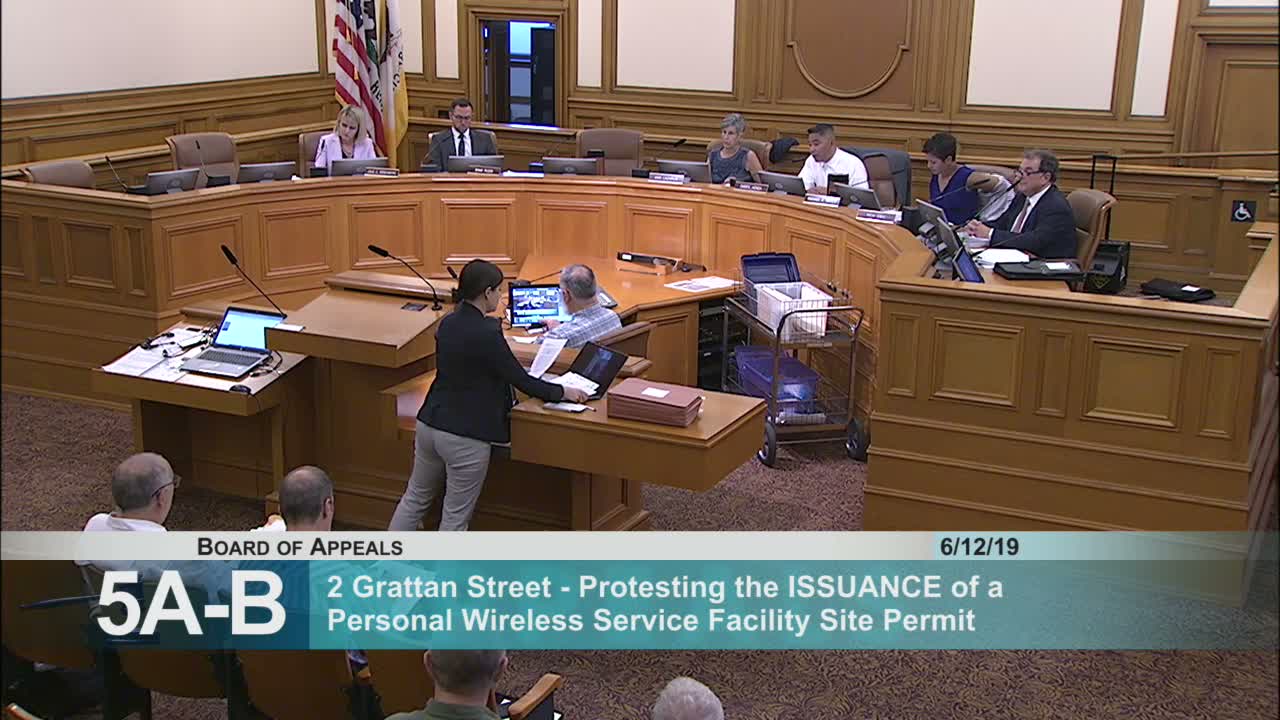
The San Francisco Board of Appeals on June 12 continued two appeals of a Department of Public Works permit for a Verizon personal wireless facility at 2 Grattan Street to July 17 so planning staff can verify records, plan versions and equipment details.
Neighbors and expert witnesses told the board the project does not meet the Article 25 Tier 2 compatibility standard because of its height and the quantity and placement of equipment boxes. Eliza Nemzer, an appellant, told the board the planning department’s March 2018 disapproval cited three specific defects — added height, increased visibility and “distracting and cluttering” equipment — and she said those problems persist in plans the department later approved. “The height of the antenna didn’t change an inch,” Nemzer said, arguing documentation cited by the city was inconsistent and misleading and that the pole is visible along roughly 180 feet of Belvedere Street.
Verizon’s outside counsel, Paul Albritton, said the company had conducted an alternatives analysis, reduced the proposed height and designed narrow, passively cooled radios to minimize pedestrian‑level impacts. “We feel that that is the appropriate characteristic that we met,” Albritton said, adding the radios are mounted above pedestrian sight lines and that required switches and meters would be between about 7 and 8 feet per PG&E requirements.
Planning staff, represented by Scott Sanchez, told the board that the original staff disapproval focused on a higher initial proposal but acknowledged some cited documents may have referenced the lower, 40‑foot design. Sanchez said staff had subsequently worked with the applicant and public works on a revised design with a maximum height of 40 feet and asked for time to ensure the record and internal communications are fully reconciled.
Appellants and several neighborhood residents urged the board to consider aesthetics and historic context. Frances Dependal and other speakers described the site as a neighborhood square used for gatherings and said the pole and equipment would detract from a street of mostly three‑story Edwardian houses. Resident Adam Tarnoff said his bedroom window sits about 15 feet from the existing pole and that additional equipment would materially change his view.
On technical and safety questions, Nemzer and a witness with a geoscience background argued that Federal Communications Commission exposure standards date from the 1990s and do not address modern LTE/4G or new 5G deployments. Albritton and Verizon technical representatives countered that exposure standards are reviewed by technical bodies and that the frequencies and exposure metrics cited are within the applicable standards; Public Works and Planning staff noted Department of Public Health review procedures and availability to respond by email.
Because appellants highlighted apparent inconsistencies in plan dates and the planning department’s written determinations, Commissioner Daryl Honda moved to continue the matter so staff could verify whether the process was properly followed and supply clarifying materials about the height, the equipment to be mounted and the planning review that led to approval. The board amended the motion and settled on July 17 as the next hearing date; the motion passed (voice vote recorded as Aye by the commissioners present). The board directed that parties have standard hearing time at the continued session and that staff try to have the planner or supervisor who prepared the prior determinations available.
The appeal will return on July 17 with additional departmental clarification on plan versions, equipment dimensions and any other relevant documents.