Get Full Government Meeting Transcripts, Videos, & Alerts Forever!
Get email alerts on the Water Supply topic
No spam. Unsubscribe anytime.
Planning Commission certifies San Francisco Groundwater Supply Project EIR; coastal permits advanced
Summary
The commission certified the Final Environmental Impact Report for the San Francisco Groundwater Supply Project and approved related CEQA findings, a general-plan referral and coastal‑zone permits for three well sites. Staff said the project would help diversify supply but contributes to program-level growth impacts, and the vote to certify was unanimous.
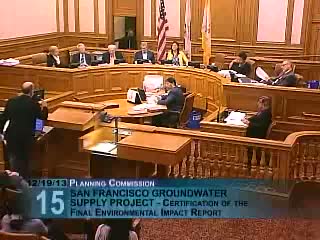
The San Francisco Planning Commission voted Dec. 19 to certify the Final Environmental Impact Report (EIR) for the San Francisco Groundwater Supply Project, a proposed program to develop local groundwater wells and pipelines as part of the SFPUC’s Water System Improvement Program.
PUC project manager Jeff Gillman told commissioners the project would include up to six wells, approximately five miles of pipeline and blending of groundwater at Sunset and Sutro reservoirs to reduce reliance on imported surface water. He summarized the project’s objective and said the project would “pump an average of 4,000,000 gallons per day” from the Westside Aquifer in typical operation.
Why it matters: Planning staff concluded the project’s site‑level impacts could be mitigated but that the project contributes to an unavoidable program‑level growth inducement impact previously identified in the WSIP program‑level EIR. Staff recommended certifying the EIR and adopting CEQA findings; the PUC would need to adopt a statement of overriding considerations if it chooses to approve the project.
Public comment and response: Members of the public raised groundwater and health concerns about tire‑crumb infill at Golden Gate Park fields and urged postponement pending litigation and additional toxicity analysis. Staff and PUC answered questions about monitoring and mitigation, describing stepwise mitigation measures that could include reducing or ceasing pumping if monitoring showed impacts to Lake Merced or biological resources.
Vote and follow-up: The commission certified the EIR and then approved motions to adopt CEQA findings, the general plan referral and coastal permits for three coastal sites (Lake Merced, South Windmill replacement, North Lake). Each motion carried unanimously. Staff said the PUC will continue coordination with Rec & Park on Golden Gate Park sites; the Lake Merced facility will include an interpretive overlook and green roof as described in the staff presentation.
Next steps: The PUC must consider those findings and, if it chooses to approve construction, adopt a statement of overriding considerations for the program‑level impacts and proceed with project permitting and mitigation monitoring as required under the adopted measures.