Get Full Government Meeting Transcripts, Videos, & Alerts Forever!
Get email alerts on the Small Business topic
No spam. Unsubscribe anytime.
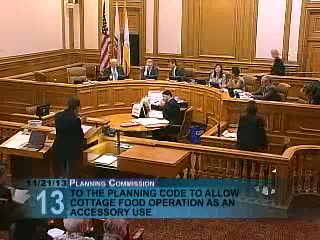
Commission recommends code changes to allow cottage food operations under state law
Summary
The commission recommended approval of a Planning Code amendment to allow cottage food operations as accessory uses and expand allowable accessory area, aligning San Francisco rules with state AB 1616 while preserving health oversight via DPH referrals.
The Planning Commission recommended approval on Nov. 21 of an ordinance, sponsored by Supervisor Jane Chu, to amend the Planning Code to allow cottage food operations (CFOs) as accessory uses in dwelling units and to expand the maximum accessory area from one quarter to one third of a unit’s floor area.
Aaron Star from the Planning Department explained that the ordinance brings the city into compliance with AB 1616 (the Cottage Food Act), which became effective Jan. 1, 2013 and prohibits blanket local bans on home kitchens producing food for sale. The proposed approach combines lower‑burden local rules with basic protections: CFOs would not require a use permit from Planning (eliminating discretionary review) but would need a Department of Public Health permit, and DPH would refer permits to Planning for a limited review to confirm the operation is within a legal dwelling unit and to check for enforcement flags.
Commissioners raised questions about health oversight and the types of food that can be prepared; staff noted the state law sets two tiers of CFOs (less intensive Tier A and more intensive Tier B) with DPH inspection frequency and identified a one‑time referral fee to Planning for recordkeeping. Commissioner Antonini asked whether larger accessory uses could reduce housing supply; staff said the department expects limited uptake and was recommending a modest expansion to 1/3 of floor area. The commission voted unanimously 6–0 to recommend approval.
Next steps: The matter will move to the Board of Supervisors for consideration; DPH will continue to handle health permitting and inspections as required by state law.