Get Full Government Meeting Transcripts, Videos, & Alerts Forever!
Get email alerts on the Labor Enforcement topic
No spam. Unsubscribe anytime.
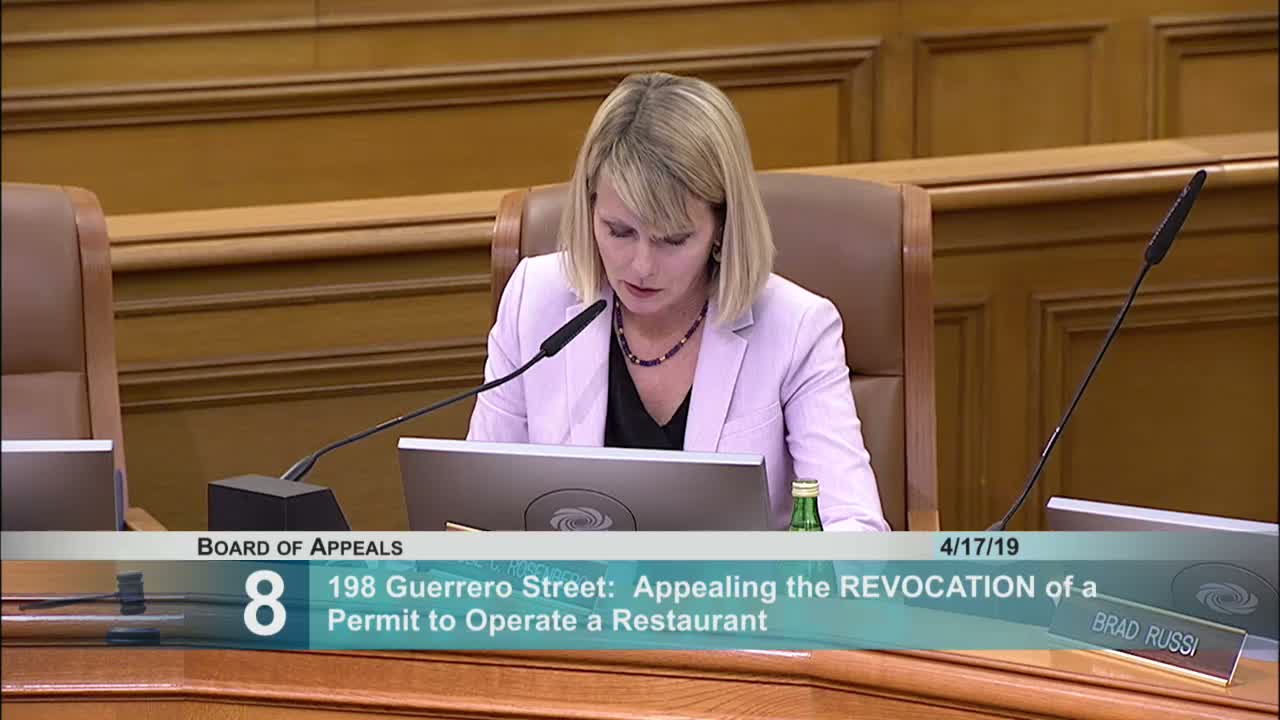
Board upholds DPH revocation of Mission Beach Cafe's permit after finding Health Care Security Ordinance violations
Summary
After extended testimony, the Board of Appeals upheld the Department of Public Health's revocation of Mission Beach Cafe's permit for repeated health and labor ordinance violations. The owner and counsel cited bankruptcy and imminent funds; DPH and OLS enforcement said the business never made required payments and remains out of compliance.
The San Francisco Board of Appeals on April 17 upheld the Department of Public Health's March 5, 2019 revocation of Mission Beach Cafe's restaurant permit, concluding that the department had authority to revoke the permit based on long-running violations of the Health Care Security Ordinance (HCSO) and separate public-health abatement requirements.
Counsel for Mission Beach Cafe, Matt Metzger, and owner Bill Clark asked the board for time to resolve audit liabilities through the owner's pending personal bankruptcy and said an immediate partial payment and a trustee distribution would be available in the coming weeks. Metzger said a $14,000 payment could be made by mid-May and pledged $2,000 per month thereafter while bankruptcy proceedings and possible asset sales continue.
Department of Public Health representative Molly Alarcon and Office of Labor Standards Enforcement compliance officer Bianca Polavina told the board the revocation was grounded in a final determination that the cafe violated the HCSO and in separate DPH abatement requirements. OLS enforcement summarized an audit period (2014'2017) that produced a finding of approximately $77,000 owed to workers and noted the city had placed that amount with the Bureau of Delinquent Revenue for collections. Polavina told the board the business never paid the assessed amounts nor engaged successfully in negotiated settlement efforts.
Tenant and worker advocates told the board they had won separate judgments and civil claims tied to unpaid wages and that some former workers suffered medical bills after illnesses for which they lacked employer-provided coverage. An attorney for 10 former employees said the group holds a judgment from San Francisco Superior Court for approximately $1.3 million on a range of wage-and-hour claims; counsel said those employees have not waived their rights in bankruptcy.
During deliberations Vice President Rick Swig moved to deny the appeal and uphold DPH. That motion failed on a recorded vote. The board then sustained the DPH revocation and the restaurant's permit was revoked at the conclusion of the hearing.
What the record shows: OLS enforcement credited an audit that produced a $77,000 assessment for the audit period and said there has been no collection to date; DPH separately issued an abatement order requiring sanitation and vermin-proofing work that remains under oversight. The owner countered that two detailed health inspections and subsequent publicity (including a low inspection score) triggered revenue declines and eventual bankruptcy that hindered the business's ability to pay, and that trustee-held funds could be available to make an initial payment in May.
Why it matters: The decision removes the cafe's permit to operate and underscores that the city can use permit revocation as leverage when employers fail to comply with local labor- and public-health requirements, even where business bankruptcy is ongoing.
Next steps: The revocation is effective as recorded in the board's action; the owner may pursue any available administrative or legal remedies outside the board record.