Get Full Government Meeting Transcripts, Videos, & Alerts Forever!
Get email alerts on the Air Quality Nuisance topic
No spam. Unsubscribe anytime.
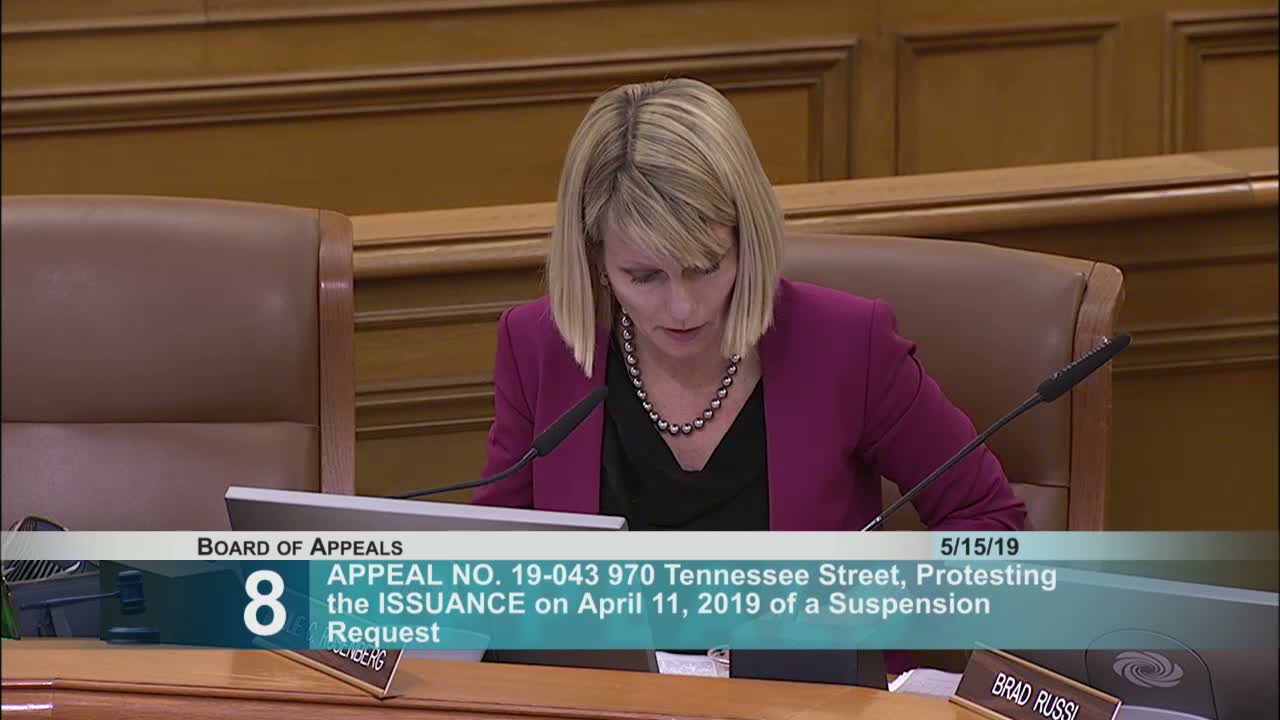
Board of Appeals amends violation order for longtime restaurant nuisance; sets 12‑week deadline tied to corrective permit
Summary
After extensive public testimony about years of smoke and odor drifting from a nearby restaurant into a multiunit building, the San Francisco Board of Appeals granted an enforcement appeal and amended the notice of violation to require the restaurant to obtain a corrective permit and complete installation within 12 weeks of permit issuance or face daily penalties.
The San Francisco Board of Appeals on May 15 amended a planning department notice of violation for persistent smoke, grease and odor emissions from a neighborhood restaurant, ordering a corrective permit and a 12‑week completion deadline after permit issuance or the start of daily penalties. The board emphasized both the serious health complaints from nearby residents and the need for a definitive timetable to secure compliance.
Neighbors from 55 Page Street told the board that cooking smoke has fouled their apartments for years, with several speakers reporting medical effects and ongoing out‑of‑pocket costs for filtration. “I am unable to enjoy my unit,” said tenant Nathan Coopland, describing respiratory irritation and sleepless nights when smoke blows into his home. Multiple speakers said the problem intensified after unpermitted or interim work on the restaurant’s venting system.
The city’s planning staff and the restaurant’s representatives described a negotiated technical solution. Justin Zucker, counsel for the property owner and restaurant, said the business has submitted plans for a high‑efficiency filtration system (a so‑called grease‑viper or electrostatic precipitator) and that permitting is underway: “Once we obtain permanent approval, we are ready to proceed with the grease viper,” he told the board. Planning staff said the proposal has been revised in response to agency comments and neighbors’ input and that a notice of special restrictions will accompany the corrective permit.
Planning staff and the board also reviewed the enforcement history: a series of complaints to the Bay Area Air Quality Management District and to city departments dating back years, an enforcement investigation and a notice of violation and penalty decision issued by Planning. Scott Sanchez of the Planning Department told commissioners staff concluded the operation had become a public nuisance and recommended action to secure abatement.
After questioning about technical feasibility and timing, the board voted to grant the appeal in part and amend the planning department’s enforcement order to attach a firm compliance schedule. Under the board’s direction, penalties will begin to accrue on the date of issuance of the corrective permit and will be collectable if the restaurant does not achieve a final certificate of compliance (final inspection/CFC) within 12 weeks of that permit’s issuance. The board directed planning staff to memorialize the timeline and the conditions in the written decision to be issued following the rehearing window.
The decision balances neighbors’ calls for prompt enforcement with the departments’ and the restaurant’s argument that the specified mechanical system requires design, structural review and permitting before installation. Planning staff said they would continue to coordinate the technical review and offered to work with the parties to minimize the time to issuance.
The board’s written order will state the exact penalty start date and the reporting requirements; the decision will be final after a 10‑day rehearing period.