Get Full Government Meeting Transcripts, Videos, & Alerts Forever!
Get email alerts on the Property Rights topic
No spam. Unsubscribe anytime.
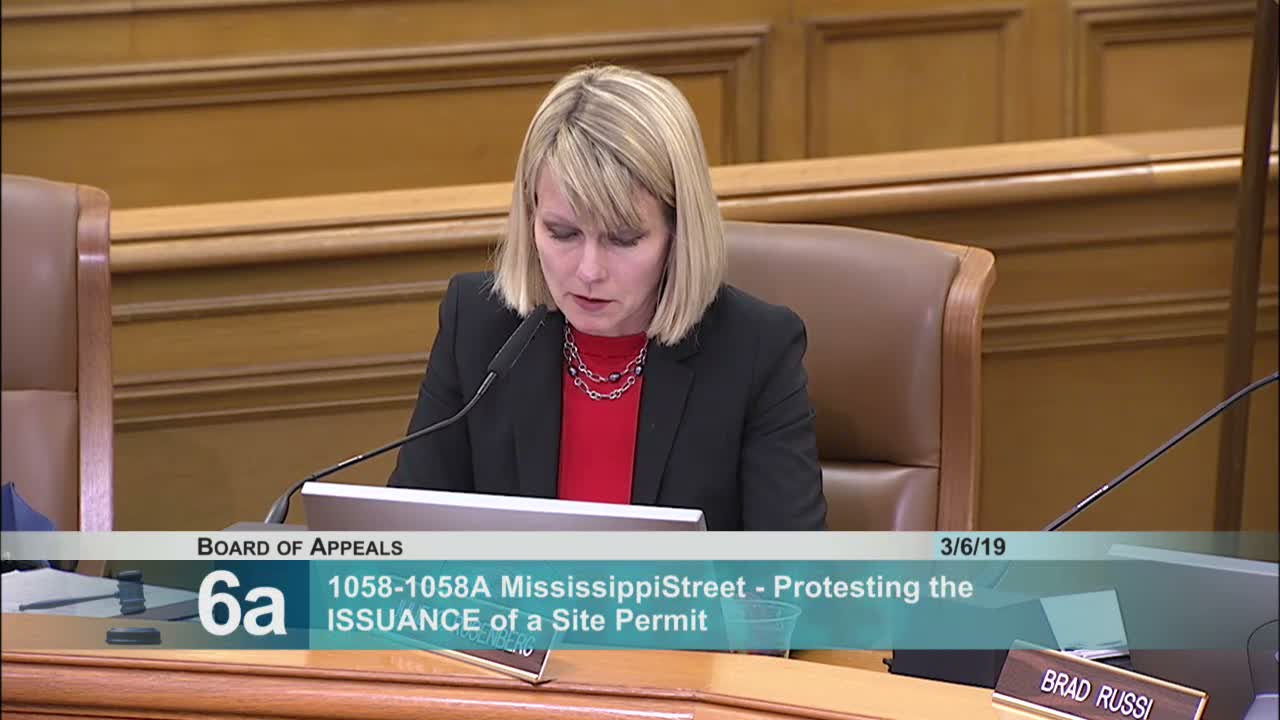
Board continues Mississippi St. site-permit dispute to March 27 to allow easement talks
Summary
The Board of Appeals continued a contentious appeal over a site permit at 1058 Mississippi St after neighbors raised a prescriptive-easement claim; the planning and building departments said the permit is code-compliant but that an easement is a civil matter; the board set a March 27 continuance to let parties pursue an agreement and DBI review.
The San Francisco Board of Appeals continued action on an appeal of a site permit for 1058 Mississippi Street to March 27 to give the parties time to negotiate a resolution of a disputed easement claim.
Appellants Elena Myers and her son Max Schmieder said the rear cottage on their lot has relied on an access path across the neighboring lot for decades and that the new project at 1058 Mississippi would enclose that access and diminish their rights. Schmieder said the family has occupied the property since 1981 and argued the enclosure would eliminate a prescriptive easement and significantly harm their property and access.
The project sponsor and design team (CIAR/SEER Consulting) said no recorded easement appears in title records and that the proposed plans provide an internal corridor and other mitigation: monitoring of adjacent buildings, underpinning/engineering oversight by a third-party engineer at the developer’s cost and an offer to create an access corridor or intercom-controlled passage. The sponsor said it is willing to negotiate terms but disputed the claim that a recorded easement exists.
Planning Department acting ZA Scott Sanchez and DBI Senior Inspector Joe Duffy told the board that planning review found no condition requiring the existing rear trees or access to be maintained and that on its face the site permit is code-compliant. Both agencies said a prescriptive or recorded easement is a civil matter best resolved in court or by private agreement; DBI suggested a pre-application meeting and said alternate means (sprinklers, panic hardware, and other mitigations) can sometimes address egress concerns.
Several commissioners expressed sympathy for the longstanding resident and concern about construction-phase access for the rear cottage. Vice President Rick Swig moved to continue the matter to March 27 to give the parties short time to attempt a written agreement and for the developer to consult with DBI about whether the proposed internal corridor could be made code-compliant as an easement if granted. The motion carried.
The continuance gives both sides time to pursue either a civil resolution (for example, a recorded easement) or to present DBI-approved alternatives that would meet egress and life-safety requirements. If the parties do not reach agreement by March 27, the board indicated it may proceed to rule on the permit or consider the motions proposed by commissioners.