Get Full Government Meeting Transcripts, Videos, & Alerts Forever!
Get email alerts on the Healthcare Master Plan topic
No spam. Unsubscribe anytime.
San Francisco planning and health commissions endorse Health Care Services Master Plan, approve priority-processing incentives
Summary
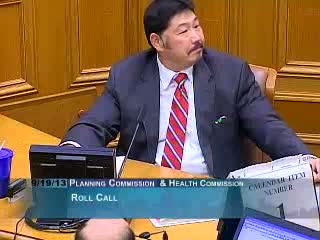
The Planning Commission and Health Commission voted on Sept. 19, 2013 to recommend the Health Care Services Master Plan and adopt CEQA findings. The draft clarifies consistency-review thresholds and emphasizes incentives such as priority processing, cultural competency, and mental-health integration.
San Francisco planning and health officials on Sept. 19 recommended a revised Health Care Services Master Plan that staff say will guide where and how medical uses are sited and how the city will encourage services for vulnerable neighborhoods. The Planning Commission voted unanimously to forward the plan to the Board of Supervisors and to adopt related CEQA findings; the Health Commission also voted to advance the draft.
Colleen Chavla, deputy director of health, opened the joint hearing by describing the plan as the product of a 40-plus-member task force and more than 100 community participants. “This represents really comprehensive data and [a] community-driven process that included a 40 plus member task force,” Chavla said, and staff presented a revised draft that incorporated public and commissioner comments from July hearings.
Planning staff outlined the scope and technical rules the plan would impose. Claudia Flores of the Planning Department said the ordinance (Ordinance No. 310) requires a consistency determination for medical uses that meet defined size thresholds: a change of use to medical use of 10,000 square feet or greater, or an expansion of an existing medical use by 5,000 square feet or greater. Flores told commissioners that Planning will perform an initial check for medical use and size, forward applications to Department of Public Health staff for an initial determination, and then complete the consistency determination.
Staff also clarified how the plan will treat guideline designations. A narrower set of guidelines are now identified as eligible for development incentives—initially characterized by staff as priority processing—while the plan treats all recommendations and goals as critical to the city’s health objectives. Flores said the three possible consistency outcomes are: consistent and recommended for incentives (eligible for expedited review and other possible incentives), consistent (meets goals but not incentive thresholds), or inconsistent (projects judged to harm health care access).
The draft was revised in response to public comment to strengthen several areas. Staff expanded guidance on assessing the local density of health services so incentives target neighborhoods with unmet need; they amended recommendations to encourage culturally competent providers (guidelines 3.1.2 and 3.1.8); they revised language to encourage greater private physician participation in Medi‑Cal (guideline 3.1.9) and expanded recommendations integrating behavioral health into primary care (guideline 3.2.01) and community-based mental health services (3.2.4). The plan also adds a section designating the master plan as a living “Health Policy Resource” to inform broader citywide policy beyond land-use decisions.
Several public speakers praised the process and urged adoption. Susan Fay, a health policy fellow with the Chinese Progressive Association, said some suggested edits were included but urged clearer, more explicit language around community engagement and where new services would be targeted (she cited neighborhoods such as Excelsior and Bayview). Hillary Ronan, a legislative aide for Supervisor David Campos, thanked staff and task-force chairs and urged the commissions to adopt the plan as landmark legislation.
Commissioners pressed staff on implementation details. Commissioner Antonini asked whether the plan would unfairly disadvantage medical facilities that serve many non-San Francisco patients and whether cultural-competency requirements could interfere with hiring; staff responded that a project that does not meet incentive criteria can still be deemed "consistent" and proceed through the usual planning process, and that incentives will be applied "on balance" rather than by an automatic numeric count. Commissioners asked for clarity on what incentives would look like; Flores said the department is starting with priority processing because it already exists in practice and will continue exploring options such as fee deferrals, while noting some incentives could require separate legislation.
A motion to adopt a recommendation for approval to the Board of Supervisors and to adopt the CEQA findings was moved and amended on the floor: one amendment replaced the word “rely” with “utilize” to emphasize active use of the plan as a policy tool; the amendment was accepted. The Planning Commission recorded a unanimous vote in favor (7–0). The Health Commission then voted by name to support advancing the draft.
Staff indicated next steps: the environmental review is finalized, and after both commissions’ approvals staff anticipates forwarding the master plan to the Board of Supervisors in winter 2013–2014. The plan is written as a living document to be updated approximately every three years and staff said they expect to continue refining incentive options before implementation.
The joint meeting adjourned after no further public comment.