Get Full Government Meeting Transcripts, Videos, & Alerts Forever!
Get email alerts on the Public Notice Wireless Permit topic
No spam. Unsubscribe anytime.
Board of Appeals denies neighbors’ challenge to wireless permit at 1509 Schrader Street
Summary
The San Francisco Board of Appeals on Dec. 12 denied an appeal challenging the issuance of a personal wireless service facility permit at 1509 Schrader St., concluding the notice process met Article 25 requirements after the department and permit holder corrected an earlier neighborhood-mailing error.
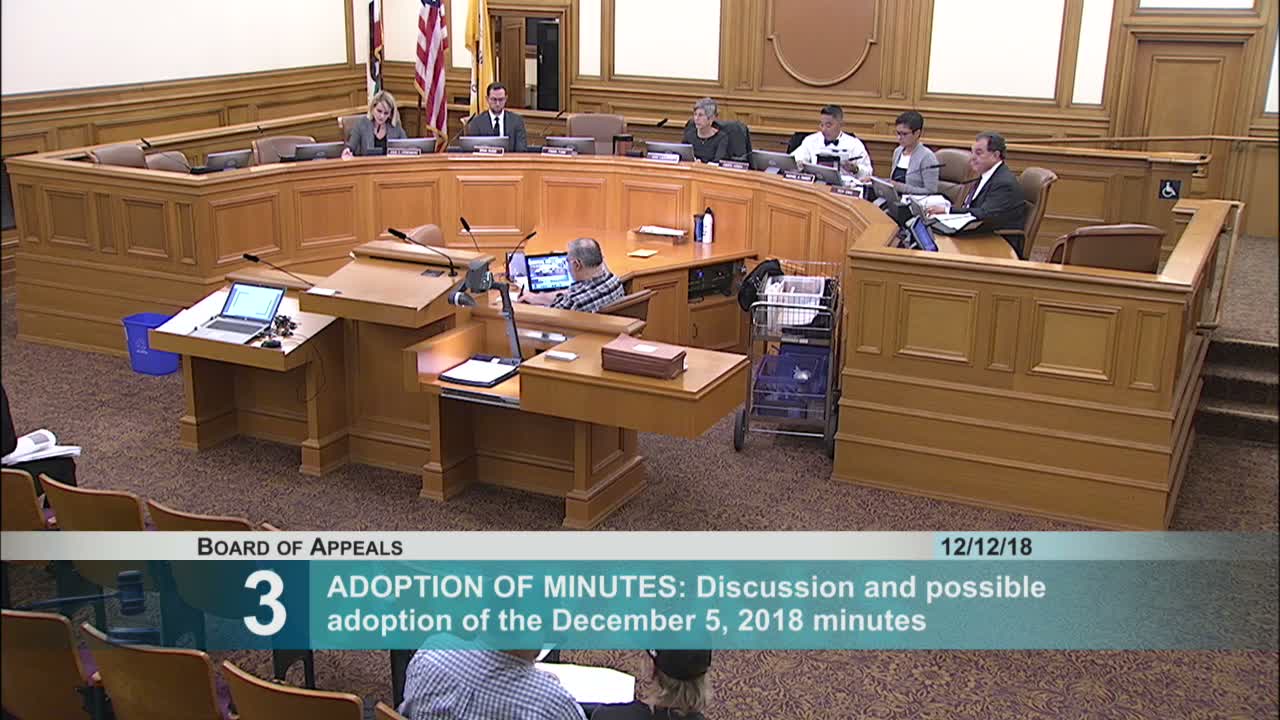
SAN FRANCISCO — The San Francisco Board of Appeals voted Dec. 12 to deny a resident challenge to a personal wireless service facility permit for 1509 Schrader Street, rejecting claims that the Department of Public Works and the permit holder failed to give legally required notice.
In a 3–0 vote, Commissioners Darryl Honda, Rachel Tanner and Vice President Rick Swig voted to deny the appeal after hearing testimony from Public Works and neighbors. Commissioner Anne Lazarus moved the motion to deny the appeal; the motion carried. The board cited evidence that the department and the permit applicant had used the notice steps required by Public Works Code Article 25 and that corrections were made where the initial neighborhood mailing list contained errors.
The appeal centered on whether the notice procedures under Article 25 were followed at several stages: tentative approval (mailing and posting), the department’s administrative hearing notice and the final determination notice. Jillian Gillette, transportation coordinator for the Bureau of Street Use and Mapping, described the department’s process and said the department requires multiple forms of notice at each step. She told the board that a tentative-approval mailing and posting were performed May 30 and that department emails and applicant postings were produced later in the process.
"We require two forms of notice at each step," Gillette said during her presentation, explaining the department’s use of mailed notices, pole postings and email for neighborhood groups. She also said the department identified and asked the applicant to correct an initial mailing that listed neighborhood associations for the wrong area.
Permit-holder David Nagel of Mobility told the board Mobility mailed the tentative-approval notice on May 30, posted the tentative notice on two poles nearby, and later posted the final-determination notice; he said the mailing covered roughly 30 lots and 59 addresses within the required 150-foot radius. "Everything that circle touches, we mailed," Nagel said, noting the applicant corrected an initial mailing that had referenced the wrong neighborhood groups.
Neighbors and the appellant argued the notices were sent to incorrect neighborhood associations (SoMa instead of the Coal Valley/Haight‑Ashbury lists referenced by residents), that posted notices were late or not posted multiple times on the block face, and that the notice imagery misrepresented equipment scale. Residents cited petitions and correspondence: the appellant referenced a petition of 115 signers and about 28 letters, and witnesses said at least 11 of 37 occupied residences within the 150-foot radius did not receive the May mailing.
"There were a number of significant failures to provide proper public notice," the appellant’s representative said, adding that the wrong neighborhood associations were included in the initial mailing and that posting and timing requirements were not met.
Board members pressed DPW and the applicant on the mailing lists, the department’s practices for emailing neighborhood associations and the risk that mass emails could land in spam folders. DPW representatives said the department generally requires both mail and posting for tentative approvals and additionally requires email and posting for internal hearings and final determinations.
The board's decision to deny the appeal was grounded in the record that the department discovered and moved to correct the neighborhood-mailing error, that multiple notice methods were used at different stages, and that protesters had opportunities to file protests and attend the administrative hearing. Commissioners who voted to deny the appeal said they were sympathetic to neighbors’ concerns about visual impacts and process but were constrained by the notice standards in Article 25.
The board did not order the permit revoked; the appeal was denied and the permit remains in effect. Neighbors may pursue other administrative remedies if they believe other legal requirements were violated.
The board adjourned the item and moved on to other matters.