Get Full Government Meeting Transcripts, Videos, & Alerts Forever!
Get email alerts on the Wireless Siting topic
No spam. Unsubscribe anytime.
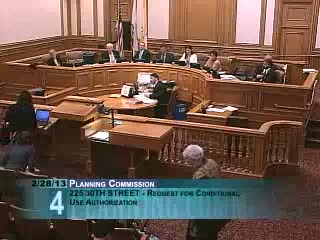
Planning commission approves AT&T rooftop antennas at 225 Thirtieth amid neighborhood objections
Summary
After neighbors raised concerns over necessity, aesthetics and health, the commission approved AT&T’s request to install nine panel antennas on the rooftop of a daytime residential care facility with conditions; the company’s third‑party engineering consultant presented drive‑test results that the commission accepted.
The commission voted to approve a conditional use authorization allowing AT&T to install a wireless telecommunications facility with nine panel antennas on the rooftop penthouse of a daytime residential care facility at 225 Thirtieth Street.
Planning staff introduced the request and said the site is a preference‑1 location under the city’s wireless siting guidelines. Teddi Berheas, AT&T’s director of external affairs, said the installation is intended to add capacity and coverage in an area served by the F and J Muni lines and several bus routes. AT&T submitted a third‑party review and radio‑frequency testing; the carrier said the antennas will be mounted with RF‑transparent screening to minimize visual impacts.
Neighbors and residents testified strongly against the proposal. Stephen Strong presented field tests from multiple locations in the neighborhood and said he sees no coverage or capacity gap; Michelle Carter and Wendy Bean cited Planning Code section 303 and raised concerns about visibility and the necessity standard for approval. Speakers also raised general health concerns citing bodies of literature and asked whether alternative sites had been adequately evaluated.
AT&T’s third‑party reviewer, Bill Hammitt (Hammitt & Edison), testified that his independent calibrated drive tests during peak demand periods validated AT&T’s maps and concluded that the carrier’s coverage and capacity claims were consistent with their data. Commissioners asked technical questions and debated the weight of neighborhood testimony versus the required technical showing under city code and federal guidelines.
Commissioner Antonini said he was satisfied with the documentation of need and the independent verification of the carrier’s capacity findings. Commissioner Antonini moved to approve the project with conditions (including screening and compliance with RF standards and city submittals); the motion was seconded and passed by roll call with aye votes recorded for Commissioners Antonini, Gordon, Hillis, Moore, Wu, and President Fong. The motion passed unanimously (6 to 0).
Because federal law limits local review of RF safety to compliance with adopted standards, commissioners noted they could not deny the project based on health concerns if the installation meets federal exposure limits and city conditions.
The approval includes conditions on screening, required submittals and compliance with the city’s wireless telecommunications guidelines and any mitigation noted in the staff report.