Get Full Government Meeting Transcripts, Videos, & Alerts Forever!
Get email alerts on the Mobile Food Permits topic
No spam. Unsubscribe anytime.
San Francisco agencies outline how mobile food facility permits are reviewed and approved
Summary
Public Works, the Department of Public Health and the Fire Department told the Board of Appeals how they coordinate mobile food facility permitting, including timelines, conditional approvals and safety checks; Public Works said it issues conditional approvals while final health and fire sign-offs must follow within 90 days.
Public Works, the Department of Public Health and the San Francisco Fire Department gave the Board of Appeals a joint briefing on Tuesday about how the city reviews and approves mobile food facility permits in the public right-of-way.
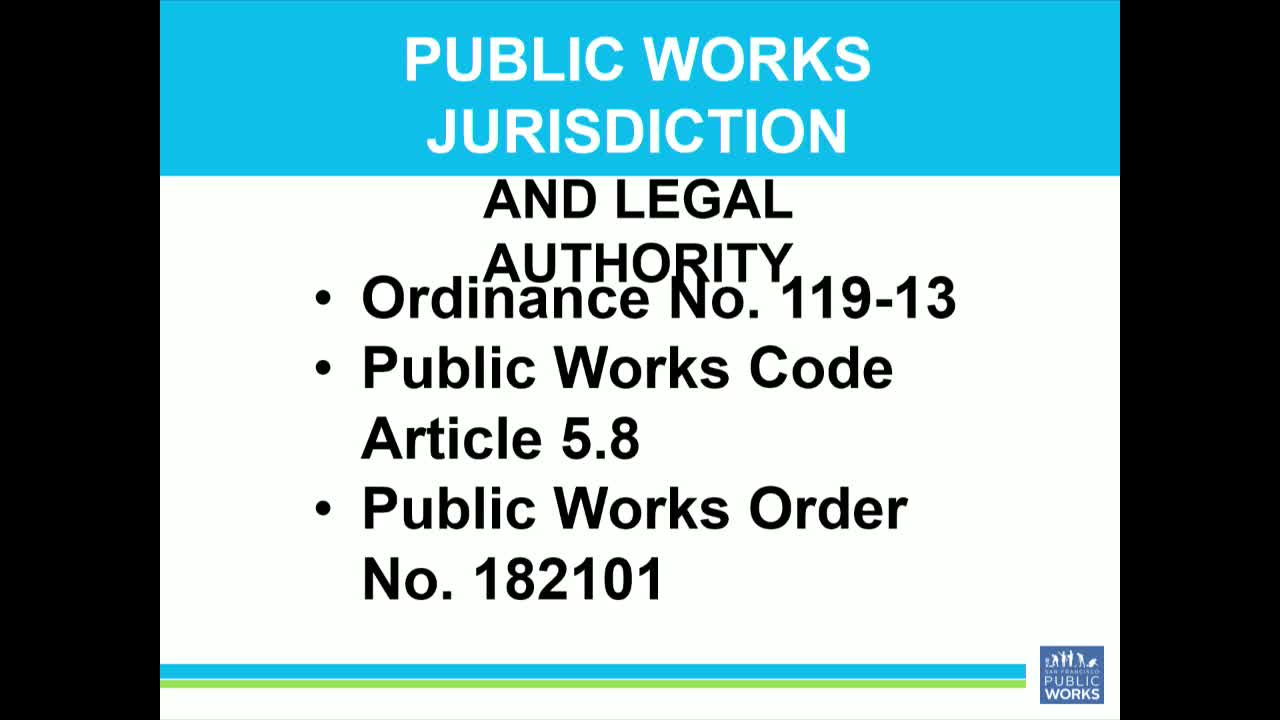
Rahul Shah of Public Works told commissioners that the Mobile Food Facility Permit process was moved to Public Works by ordinance in 2011 and is governed by Article 5.8 and implementing order 182101. "The Mobile Food Facility Permit was first introduced to Public Works in 2011," Shah said, explaining the department’s jurisdiction for location review, public notification and issuance.
Shah described the lifecycle: Public Works confirms a proposed location meets minimum clearance and location rules, completes public notification and either holds a hearing if there are objections or renders a decision within 14 days if there are none. If Public Works approves a location, it issues a conditional approval and requires the applicant to secure Department of Public Health and Fire Department approvals within 90 days; the permit is not operational until the applicant provides copies of those final approvals.
Jonathan Rubing, a senior inspector with the Department of Public Health, outlined DPH review steps for carts, trucks and trailers. DPH conducts plan review for construction and equipment based on categories of food risk, requires commissary arrangements for food preparation and verifies an accessible restroom within 200 feet. Rubing said DPH aims to perform at least one scored inspection a year and that final DPH sign-off is required before operation can begin.
Captain Mary of the Fire Department described fire-safety checks focused on LP-gas systems, generators and open flames. She said mobile kitchens are tested at the fire station and that propane tanks and piping must be permanently plumbed and subject to leak testing; failure of safety tests results in denial of approval.
Commissioners pressed agencies on enforcement of parking restrictions, how displaced vendors are relocated, and priority processing when applicants are moved for public benefit. Shah replied that relocated vendors are re-reviewed for location criteria but are typically not re-notified if they already held an approval; enforcement of parking violations rests with MTA or the agency that receives the complaint.
All three agencies said they would post the presentation materials online and continue to emphasize interagency coordination to minimize public-safety risks while ensuring procedural compliance.