Get Full Government Meeting Transcripts, Videos, & Alerts Forever!
Get email alerts on the Zoning Upper Market topic
No spam. Unsubscribe anytime.
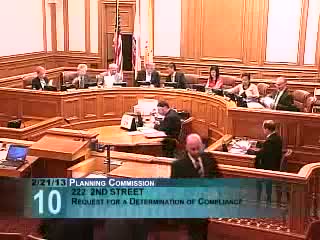
Planning Commission approves Upper Market rezoning; creates limited path to legalize Cafe Flor’s off‑site kitchen in 6–1 vote
Summary
The commission voted 6–1 to convert the remaining Upper Market Neighborhood Commercial District to a Neighborhood Commercial Transit district, clear a height question for a parcel on Market, and allow a one‑year window for Cafe Flor to obtain permits for an existing off‑site kitchen behind Noe Street. The decision followed hours of public comment both supporting and opposing a spot‑zoning exception.
The San Francisco Planning Commission voted 6–1 to recommend a package of zoning changes for Upper Market that converts remaining blocks from the Neighborhood Commercial District (NCD) to the Neighborhood Commercial Transit (NCT) zone, adjusts height designations on select parcels, and creates a limited path to legalize an off‑site accessory food‑processing kitchen used by Cafe Flor.
Supervisor Scott Wiener, who authored the measure, told the commission the package advances three goals: extend the Market Octavia plan zoning rules to the orphan block, restore intended height controls for certain lots, and provide a legal route for an existing off‑site kitchen that has operated for decades to come into compliance and continue supporting a neighborhood business.
The measure would (1) convert remaining Upper Market parcels from NCD to NCT to provide consistent density controls, (2) amend one lot’s height designation to permit up to 65 feet as part of Market Octavia‑era alignment, and (3) create a narrowly tailored accessory‑kitchen provision allowing food processing behind existing storefronts on the west side of Noe Street between Sixteenth and Beaver subject to setback and notification rules and a one‑year window to secure permits.
Why it mattered: Cafe Flor’s owner, J.D. Petrus, and many residents and neighborhood groups urged the commission to legalize the kitchen, arguing the restaurant is a long‑standing neighborhood institution that provides jobs, community space and active street life. Opponents—including nearby merchants and neighborhood associations—called the provision spot zoning that grants a unique privilege to a single parcel and raised concerns about prior code violations, public‑health complaints and fairness to other businesses.
Public comment was extensive: neighborhood merchants, community groups and longtime patrons described Cafe Flor as a community hub and requested grandfathering or a path to legalization. Other speakers, including representatives of the DeBose Triangle and Du Bois Triangle neighborhood associations, argued the off‑site kitchen confers a monopoly on one parcel and urged either rejection or a broader, citywide policy so other businesses would not be disadvantaged.
Planning staff recommended technical changes to the draft ordinance and explored a citywide approach for accessory food processing in NC districts, including removing a proposed one‑year sunset in favor of permanent, citywide criteria for off‑site kitchens. Supervisor Wiener said he preferred a geographically limited, time‑bound approach for this specific case—with a one‑year window to obtain required permits after which the use would be recorded as a legal nonconforming accessory use—so the existing business would be able to retain operations while meeting health and planning requirements.
Commissioner debate centered on whether the proposal would create an undesirable legal nonconformity or unfair special privilege. Commissioner Wu opposed the creation of a legal nonconforming use and voted no; other commissioners supported the limited remedy coupled with staff follow‑up work to consider broader, more uniform rules for NC districts.
The commission’s motion (jointly made by Commissioners Antonini and Seguerra) recommended approval of the ordinance as drafted—including the one‑year window for Cafe Flor to obtain permits—incorporated staff’s technical corrections, and directed staff to prepare separate legislation to address remaining height‑map errors and to consider broader off‑site kitchen rules for the district or city. The motion passed 6–1 with Commissioner Wu dissenting.
What happens next: The commission recommended the ordinance to the Board of Supervisors; staff will pursue trailing legislation on technical height corrections and study whether a citywide policy for accessory off‑site kitchens is appropriate. Under the approved language, the owner has one year to apply for and obtain all required permits (including health permits) to maintain the accessory kitchen; if that occurs the accessory use would continue as a legal nonconforming use thereafter.
Quote: “This legislation simply recognizes that reality,” Supervisor Scott Wiener said of the Cafe Flor kitchen, adding it provides a path “to legalize the off‑site kitchen, that has had at one location or another for several decades.”
Ending: The Planning Commission’s recommendation now goes to the Board of Supervisors; staff will return with technical corrections and follow‑up legislation as directed by the commission.