Get Full Government Meeting Transcripts, Videos, & Alerts Forever!
Get email alerts on the Central Subway topic
No spam. Unsubscribe anytime.
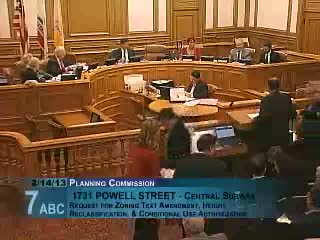
Planning Commission clears Pagoda Palace SUD and conditional use to allow Central Subway TBM removal after lengthy neighborhood debate
Summary
The Planning Commission voted to approve a special use district, height reclassification and a conditional use authorization enabling the MTA to remove tunnel-boring machines at the Pagoda Palace site, marking a critical change to the Central Subway construction plan after days of technical testimony and strong public opposition.
The San Francisco Planning Commission voted to approve a package of land-use actions on Feb. 14 that will allow the San Francisco Municipal Transportation Agency (SFMTA) to demolish the Pagoda Palace property and use the site temporarily as a retrieval shaft for the tunnel-boring machines (TBMs) on the Central Subway project.
The commission approved a special use district (SUD), a height reclassification to permit up to 55 feet on the site, and a conditional use authorization tied to the SUD. Staff and SFMTA officials told the commission the change moves the TBM extraction off Columbus Avenue and into private property at 1731 Powell Street to reduce disruption in Chinatown and to keep the larger Central Subway schedule on track.
Why it matters: SFMTA staff said the move reduces street closures and community disruption along Columbus Avenue and preserves the possibility of a future North Beach extension. MTA presenters warned that delays in providing a retrieval shaft would add city cost and risk to the Central Subway construction timeline.
What officials said: Ed Risk of SFMTA (introduced as Director of Transportation) and John Fungi, Central Subway program director, presented engineering and schedule information for the plan. Fungi described the proposed retrieval shaft as an excavation about 42 feet deep using interlocking secant piles to create a watertight wall and internal bracing; staff emphasized that the method is similar to techniques already used on other city launch boxes.
“Those machines are essentially new machines,” Fungi said, noting the contract anticipates retrieval and potential reuse or resale. SFMTA representatives said federal NEPA and local CEQA reviews govern the project and that staff would not proceed before required environmental approvals were complete.
Public response and technical concerns: Dozens of residents and business owners from North Beach and Chinatown addressed the commission during an extended public-comment period. Speakers raised technical and financial objections (some citing an outside report that assumed a deeper shaft), concerns about groundwater dewatering and adjacent building impacts, and small-business and tourism impacts on North Beach restaurants and merchants. Opponents called for extracting the TBMs at the originally analyzed Chinatown site or for burying the machines to avoid disruption in North Beach.
Supporters, including neighborhood residents advocating transit expansion, argued the Pagoda alternative reduces disruption in the public right-of-way, removes a blighted structure and helps preserve the option of extending the tunnels to North Beach in the future.
Commission discussion and conditions: Commissioners pressed staff on geotechnical reports, the depth of borings, and potential impacts on adjacent properties and utilities. Staff said property-owner borings and city geotechnical analyses informed the design but that additional borings and design adjustments would be made after demolition and early construction access. Commissioners emphasized that the conditional use should be made contingent on the Board of Supervisors' approval of the SUD and on appropriate environmental clearances.
Outcome: The package carried on the commission floor and was approved by a 4-2 vote. The motion included a modification to synchronize the term of the conditional-use approval with the SUD and directed staff to return with more detailed documentation of the engineering and environmental controls during early construction phases.
Next steps: SFMTA reported the lease and related approvals remain contingent on its board. Staff indicated the retrieval plan and final construction designs will be refined before demolition and that federal NEPA concurrence and any required CEQA steps must be completed prior to on-site work.
Key details and clarifications: The retrieval shaft depth described by SFMTA staff is approximately 42 feet; secant (interlocking) concrete piles will be drilled into an impervious layer and the interior will be excavated and braced. Extraction and associated work were described as likely to take on the order of 10—12 months of construction activity at the site. SFMTA said TBMs are funded and fabricated under the tunnel contract and have salvage value if recovered.