Get Full Government Meeting Transcripts, Videos, & Alerts Forever!
Get email alerts on the Property Notice Rehearing topic
No spam. Unsubscribe anytime.
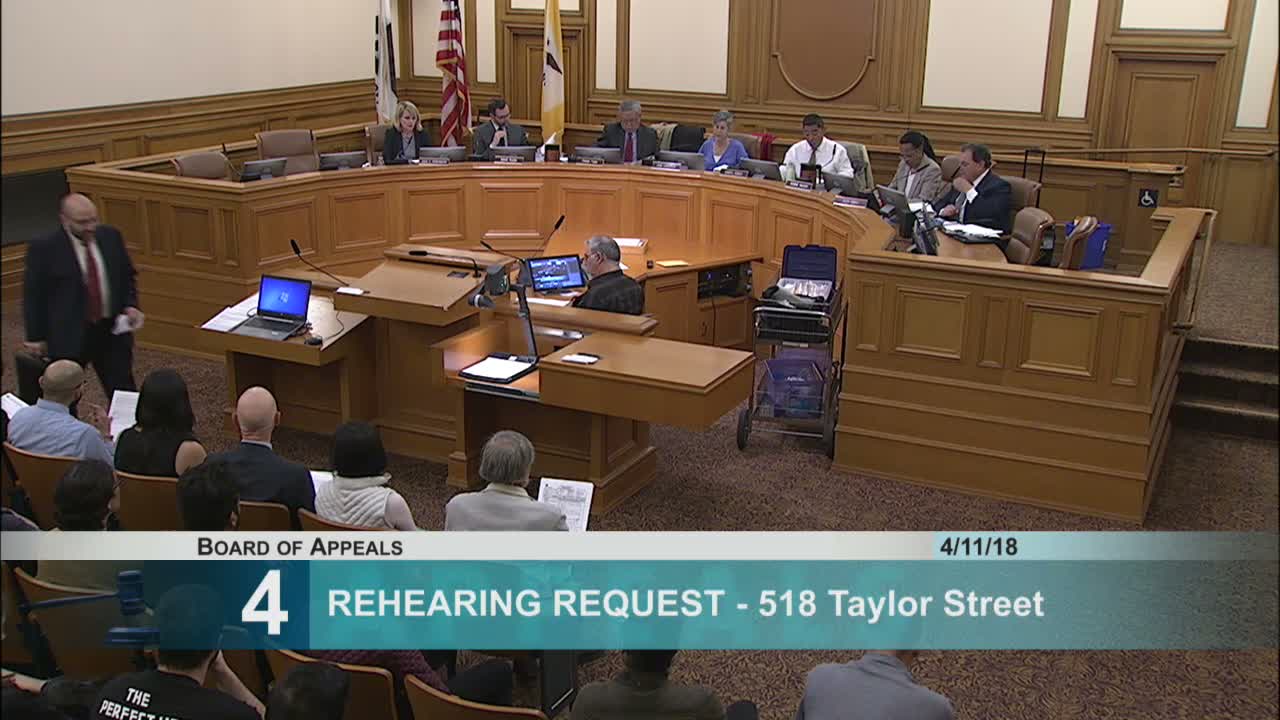
Board of Appeals grants rehearing for 518 Taylor Street over notice dispute
Summary
The San Francisco Board of Appeals voted to grant a rehearing in the appeal over a three‑year planning ban linked to a Department of Public Health enforcement action at 518 Taylor Street after evidence and department policy changes raised questions about property‑owner notice.
The San Francisco Board of Appeals on April 11 voted to grant a rehearing in the appeal involving 518 Taylor Street, a decision that reopens a prior letter of determination that triggered a three‑year ban under the planning code for an alleged massage‑establishment violation.
Counsel William Klein, representing 520 Taylor Street LP, told the board the property owner did not receive adequate notice of enforcement that led to the planning‑code sanction and asked the board to afford the owner a hearing. Mary Tran, the property manager, and the on‑site manager who identified himself in the transcript as Jeffrey pokes told the board they were not given clear written notice at the time of inspections and that the operator had admitted wrongdoing before the property owner had a full opportunity to respond.
Planning staff and the Department of Public Health (DPH) explained that the planning code ties the three‑year ban to conduct found contrary to Article 29 of the health code and that their enforcement processes historically focused on operators. Planning’s Corey Teague said the planning code does not require a formal DPH adjudication to trigger the ban but acknowledged the department has revised its notification practice to notify property owners more consistently following director‑level findings.
Commissioners said the new statements in the record and the change in DPH practice warranted reopening the matter so the property owner could seek a full hearing; a motion to grant the rehearing, made and seconded during the meeting, carried on a board vote. The board instructed staff to contact counsel William Klein to set a rehearing date and to advise parties on procedure and time limits.
Next steps: the board will set a rehearing date once the requester files the required paperwork within the statutory time period and staff coordinates the scheduling and notice procedures with the parties.