Get Full Government Meeting Transcripts, Videos, & Alerts Forever!
Get email alerts on the Wireless Infrastructure topic
No spam. Unsubscribe anytime.
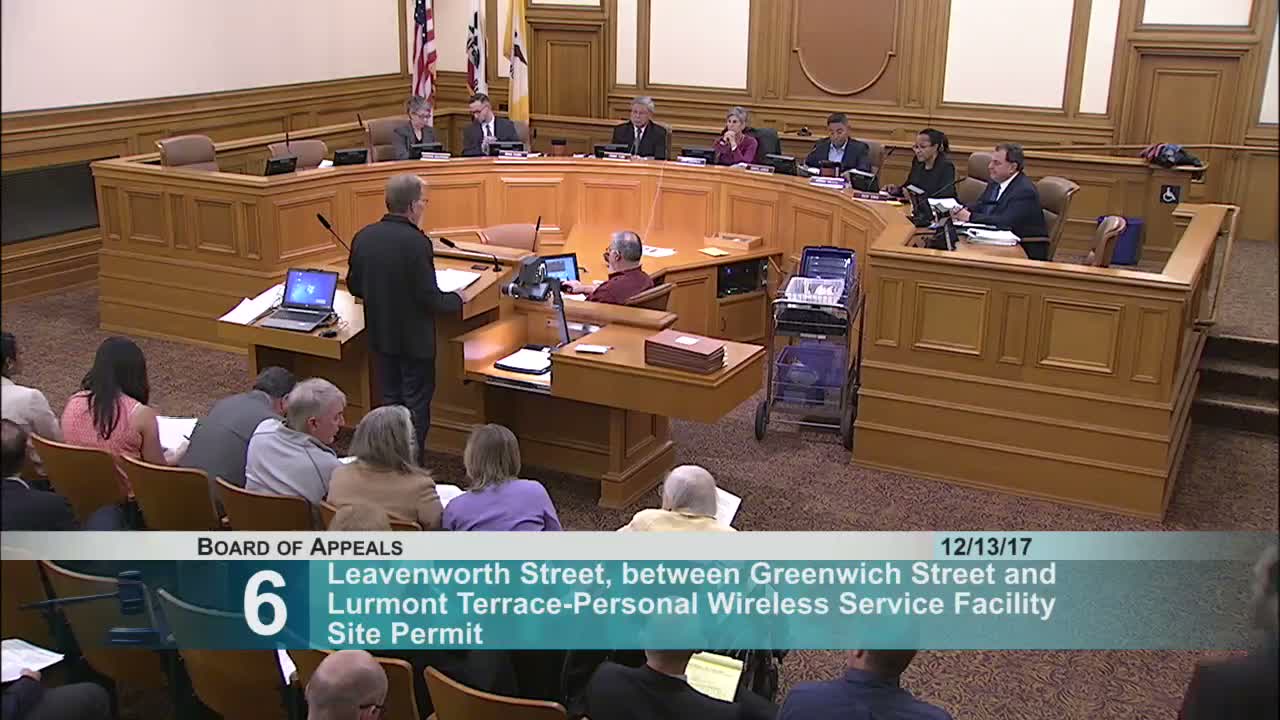
Board deadlocks on Leavenworth wireless pole; permit upheld by operation of law
Summary
Neighbors argued a proposed wireless antenna on a wood utility pole at 2201 Leavenworth would degrade an 'excellent view' corridor and worsen cumulative pole clutter; the Board's tentative motion to deny the permit received three votes and failed to reach the four‑vote threshold, so the permit remained in effect by operation of law.
Neighbors and preservation advocates urged the Board of Appeals to revoke a Department of Public Works permit for a personal wireless facility proposed for a utility pole at 2201 Leavenworth, saying the installation would degrade views toward Coit Tower and contribute to cumulative “bird's nest” clutter on wooden poles. Appellants emphasized photo simulations and nearby permits they say were denied to argue inconsistent treatment by DPW.
Extonnet Systems (Joe Camisha) and planning staff described a multiyear siting process and said the proposed unit is small (24‑inch shroud, 14‑inch diameter equipment) and painted to blend with the pole; Planning and DPW said Article 25 compatibility standards were met and that state and CPUC rules constrain pole‑top alternatives. Dozens of residents and neighborhood groups (including Russian Hill Neighbors) testified against the permit, citing aesthetic, precedent and cumulative‑impact concerns.
Commissioner Rick Swig moved a tentative motion to uphold the appeal and deny the permit on the basis that Planning's determination was incorrect and the installation would significantly impair view corridors and contribute to aggregate degradation. That motion drew three aye votes and two no votes; because the motion required four votes to carry, no formal overturn was adopted and the permit remained in force by operation of law. Commissioners directed staff to prepare findings if they later pursue a formal denial.