Get Full Government Meeting Transcripts, Videos, & Alerts Forever!
Get email alerts on the Implementation Ipic topic
No spam. Unsubscribe anytime.
City staff outlines IPIC implementation priorities and a large near-term bump in impact-fee revenue; commissioners flag transportation and maintenance concerns
Summary
Planning Department staff presented the Interagency Plan Implementation Committee report with five-year impact-fee revenue projections (including a near-term $20M bump tied to fee deferrals) and priority infrastructure projects; commissioners and public commenters urged stronger neighborhood prioritization for transportation funding and ongoing maintenance planning.
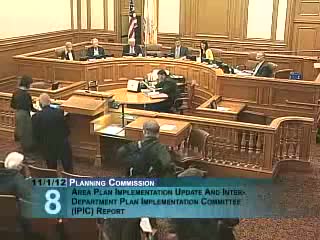
City planning staff presented an annual implementation update Thursday that laid out how development-impact fees and other public funds will be prioritized to deliver infrastructure projects from adopted area plans.
Kirsten Dissinger of the Planning Department's implementation group summarized the Interagency Plan Implementation Committee (IPIC) report, describing revenue projections and priority projects the committee recommended for the next five years. She noted the Transit Center District plan represents one of the largest implementation programs the city faces, with roughly $175 million in infrastructure work projected over 20 years. Dissinger told the commission that a large near-term bump in impact-fee receipts is expected in 2015 because several projects deferred fees and are close to occupancy; she cited a projection of about $20 million in impact-fee receipts over the next two years tied to those deferred fees.
The IPIC report prioritizes a set of projects in plan areas with near-term fee revenue, including a new park at 333 Harrison (Rincon Hill), Haight Street two-way conversion and pedestrian improvements (Market Octavia), and a park at Seventeenth and Folsom plus transit/street improvements coordinated with the Transit Effectiveness Project (Eastern Neighborhoods). The report showed tables of projected fee income and recommended allocations to match capital planning and other public funding sources such as the streets bond and potential parks bond.
Public commenters and some commissioners raised concerns about preserving neighborhood-scale input into prioritization, especially for transportation projects. Tom Radulovich (Livable City) urged the city not to lose the existing community advisory role that helps set neighborhood transportation priorities as the city considers a citywide transportation fee. Radulovich suggested general-funding support for community planning or technical assistance so neighborhoods without development-fee revenue can still produce plans.
Commissioners emphasized three recurring implementation concerns: interagency coordination for transportation and infrastructure; realistic analysis of impacts (for example, vehicle travel demand) rather than assuming all trips will shift to transit; and long-term maintenance budgeting for new parks and streetscape elements. Commissioner Antonini stressed maintenance obligations after capital installation, noting past examples where plantings and medians lacked upkeep funding.
Staff said the department is working more closely with capital planning and agency partners to align impact-fee programming with other funding sources; they acknowledged gaps remain, particularly in long-range transportation planning for South Of Market and Rincon Hill areas that no longer benefit from redevelopment-era capacity. No formal vote was taken on IPIC recommendations during the informational session. The commission will consider related budget and implementation materials as those items advance through agency capital planning and the Board of Supervisors.