Get Full Government Meeting Transcripts, Videos, & Alerts Forever!
Get email alerts on the Land Use topic
No spam. Unsubscribe anytime.
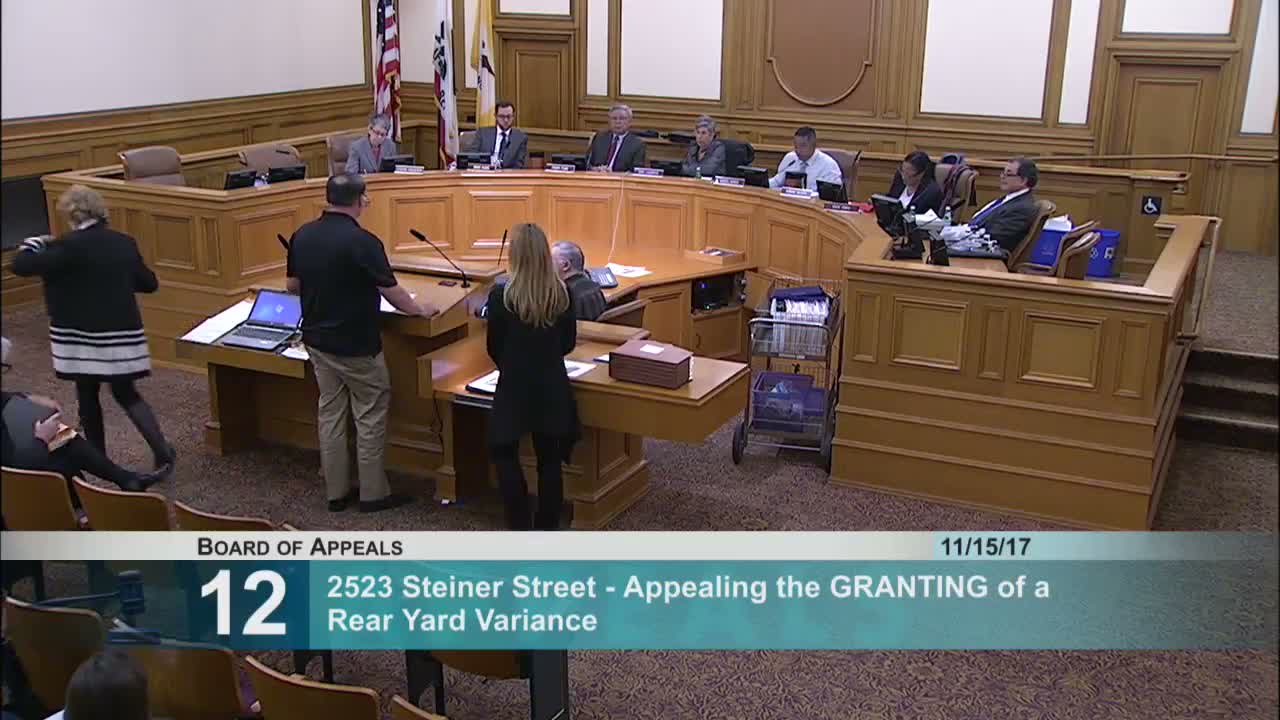
Neighbors and tenants clash as Board upholds rear‑yard variance at 2523 Steiner by default
Summary
The Board of Appeals reviewed a heavily contested variance for 2523 Steiner that neighbors say would harm light, air and privacy in adjacent rent‑controlled units. Planning Commission had disapproved the related permit; the acting zoning administrator granted a narrowed variance with conditions. The board failed to muster four votes to overturn the variance, so it was upheld by default.
A long, often partisan hearing on Nov. 15 focused on a rear‑yard variance for 2523 Steiner Street. Neighbors and tenant groups argued the proposal would reduce light and air, eliminate or box in existing rear open space, and allow deck occupants to look directly into bedrooms of adjacent rental units.
Appellant Kirk Dinero and multiple tenants presented photographs, 3‑D renderings and a record of the Planning Commission’s prior 4–1 disapproval of the associated building permit. Dinero argued the zoning administrator’s subsequent variance decision conflicted with the Commission’s discretionary denial and that the variance effectively authorized elements (rear decks/terraces) the Commission had rejected. Tenants and neighborhood organizations — including the Pacific Heights Residents Association and several tenant groups — told the board they viewed the zoning administrator’s action as an overreach that would set a damaging precedent.
The project sponsors, Jonathan and Tina McNulty, and their architect said the requested expansions are modest — limited to roughly 96–114 square feet in different iterations — intended to make a dysfunctional house workable for a growing family. Sponsors presented shadow studies that showed minimal annual light‑loss impacts (presented numbers ranged from 0–2% at selected points), described multiple scaled‑back designs offered to neighbors, and said many immediate neighbors who reviewed revised plans were either neutral or supportive.
Planning staff told the board the Planning Commission and the zoning administrator review different criteria under the City Charter and noted that a variance can be issued even if the Planning Commission disapproved the associated permit; however, staff clarified that a variance becomes practically relevant only if the disapproved building permit is overturned. The zoning administrator’s decision included specific conditions designed to reduce impacts: limiting how far terraces could be used as open space, requiring privacy glazing on north‑facing windows, and setting minimum setbacks from the adjacent property line.
In deliberations, the board considered procedural fairness (whether the zoning administrator had exceeded authority by approving elements the Commission denied) and the five findings required for a variance. Vice President Fung moved to grant the appeal (deny the variance) on the ground that the five findings were not met; the motion did not obtain the four votes required for reversal. With no successful motion to overturn, the variance remained in effect (described in the record as “upheld by default”).
What this means: the variance decision stands in the record, but the zoning administrator’s action does not remove the Planning Commission’s authority over the associated building permit. If the planning denial remains, the variance is effectively moot for construction until the sponsor either wins an appeal of the permit denial or waits the statutory period before pursuing a substantially different project. Neighbors indicated they would monitor next steps closely and consider further administrative or legal options.
Next steps: Sponsors may seek to reconcile plans with Planning staff and neighbors, or pursue an administrative appeal of any continued Planning denial. Tenants and neighborhood groups signaled intent to press for enforcement of the Planning Commission’s findings and to press the Board of Appeals’ record if the project resurfaces.