Get Full Government Meeting Transcripts, Videos, & Alerts Forever!
Get email alerts on the Telecommunications topic
No spam. Unsubscribe anytime.
Presidio Heights neighbors lose challenge to Verizon small‑cell permit after Board of Appeals split
Summary
Residents appealed a Public Works tentative approval of a Verizon small‑cell installation at 3400 Washington St., arguing Planning failed to provide required written findings and that pole‑mounted equipment would harm the historic Presidio Heights streetscape. The board considered testimony from neighbors, Verizon and city staff; a motion of intent to grant the appeal failed and the permit remained upheld by default.
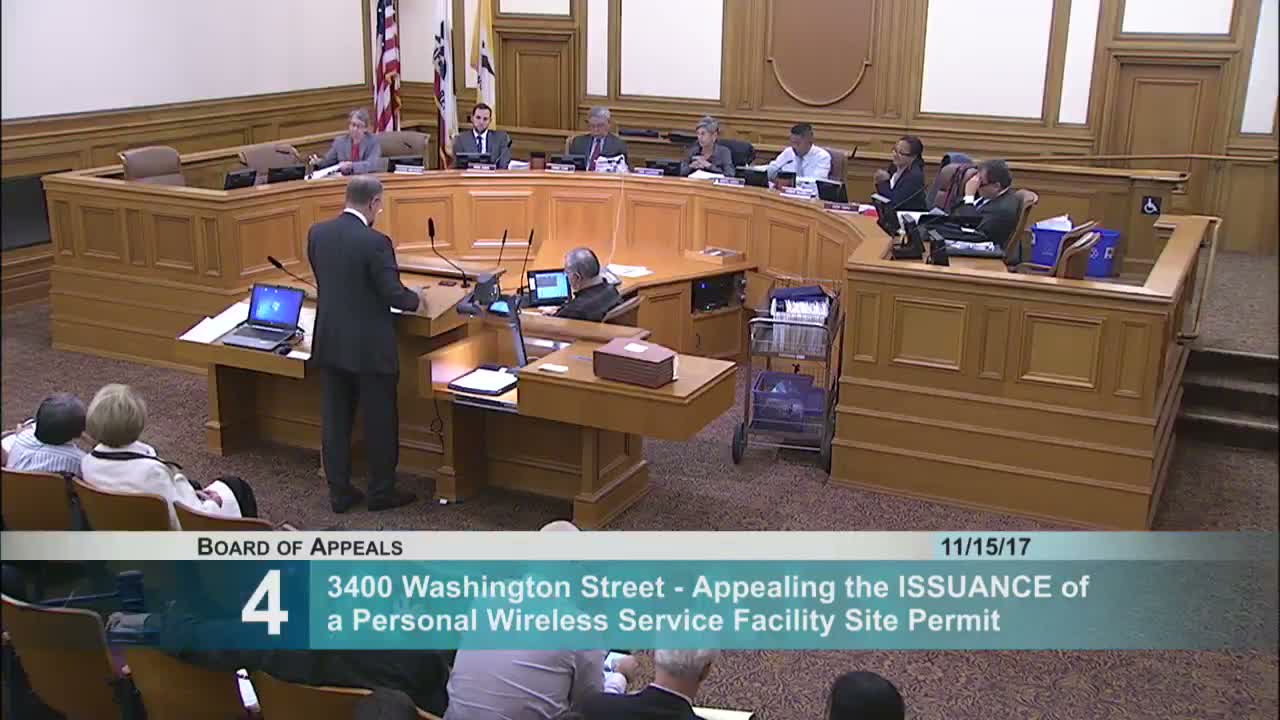
The San Francisco Board of Appeals on Nov. 15 considered an appeal by Presidio Heights neighbors of a Public Works tentative approval for a Personal Wireless Service Facility at 3400 Washington St., where Verizon proposed mounting a compact antenna and equipment on a steel street pole.
Charles Ferguson, president of the Hale (Presidio) Heights Association of Neighbors, told the board the Planning Department never supplied the written reasons required by Article 25 for concluding the facility would not significantly harm the character or aesthetics of the neighborhood. Ferguson said the neighborhood had paid to underground utilities and that placing an antenna on a pole “would reverse and destroy that accomplishment.” He urged the board to deny the permit under Article 25’s requirement that planning evaluate context-specific effects.
Verizon’s counsel, Paul Albritton, and the project team disputed that account. Albritton said the proposal emerged from a multi‑year process that involved the Public Utilities Commission and multiple reviews and that planning, public works and public health had reviewed the application and recommended approval. He described the equipment as a small, engineered “small cell” intended to add capacity within a roughly 500‑foot radius and said line‑of‑sight engineering constrained siting choices.
Public Works staff explained the procedure under Article 25: referrals to planning and public health, mailed and posted notice of tentative approval, and a public hearing on protests. Planning staff said its recommendation — to approve because the installation would not significantly impair aesthetic quality — was included in its submittal to Public Works.
Neighbors pressed two main points in public comment: that notice was limited to properties within roughly 150 feet of the pole and therefore the neighborhood association and broader block were not adequately engaged, and that cumulative or “serial” siting of multiple pole installations would erode the neighborhood’s historic, undergrounded character. Residents proposed alternative locations such as nearby rooftops, a parking‑garage site and sites within The Presidio.
Board deliberations focused on two practical questions: whether planning’s written findings adequately addressed neighborhood context under Article 25, and whether the board had enough evidence to reverse the Public Works approval. Vice President Frank Fung moved a “motion of intent” to grant the appeal on the basis that Planning’s determination of no impact was incorrect and to continue the matter to Jan. 17 so staff could prepare written findings. That motion failed on a 2–3 vote. With no other motion made, the appeal was denied and the permit upheld by default.
The board’s action leaves the Department of Public Works approval in place for the site permit. Several commissioners urged Public Works and Verizon to pursue more neighborhood outreach for future installations; others emphasized that legal limits on the city’s regulatory authority over wireless facilities constrain where and how carriers may deploy equipment. The board did not issue additional written findings beyond the record.
Next procedural steps: the Public Works decision stands unless it is separately appealed or challenged through the administrative processes cited at the hearing; some neighbors and commissioners said they would seek clearer neighborhood engagement in future small‑cell rollout planning.