Get Full Government Meeting Transcripts, Videos, & Alerts Forever!
Get email alerts on the Housing Development topic
No spam. Unsubscribe anytime.
Owner offers two below‑market units in exchange for Fillmore/Vallejo demolition and roof‑deck plan; hearing continued to November 29
Summary
The owner proposed demolishing two rent‑controlled units at 2833–2835 Fillmore and replacing them with two new units plus a shared roof deck, offering the replacements as permanent below‑market‑rate units. Staff recommended denial on housing‑conservation and neighborhood‑character grounds; commissioners continued the mandatory‑discretionary hearing to Nov. 29 to allow further negotiations with the Mayor’s Office of Housing and staff review of legal nexus and enforcement.
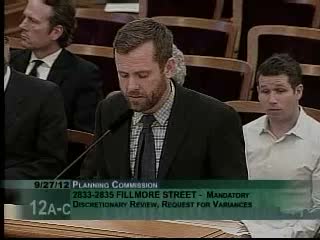
The Planning Commission continued a closely watched mandatory‑discretionary review of a proposal to demolish two vacant rent‑controlled units at the rear of 2833–2835 Fillmore and construct two new units plus a 950‑square‑foot shared roof deck serving the main Vallejo Street house and the new rear units.
Planning staff recommended denial, citing Planning Code Section 317 factors: the project would demolish two family‑sized, rent‑controlled bedrooms and replace them with two studio units (a net loss of bedrooms), would not increase the number of dwelling units, and would require multiple variances because the lots are substandard and nonconforming. Staff argued the site is at maximum density and the proposal does not meet the code’s standard expectation to conserve existing housing and neighborhood character.
The project sponsor and owner proposed a trade: in exchange for approval, the owner said he would record the two new units as permanent below‑market‑rate (BMR) units administered via the Mayor’s Office of Housing. The owner and architect argued the project corrects a historical subdivision (the small rear building dates to 1955), restores much of the yard/open space to the main historic house, replaces code‑deficient construction with new, sustainable design, and secures two permanently affordable units in a neighborhood with extremely high market rents.
Commissioners debated legal and policy hurdles: whether the city may require or accept in‑kind BMR units as mitigation on a 2‑unit project (nexus/proportionality), Costa‑Hawkins and Palmer constraints if the units are rentals, and whether the Mayor’s Office of Housing would be willing and able to accept two donated BMR units and administer them (rental or for‑sale categorization affects statutory constraints). The city attorney explained that rental restrictions for new units can be upheld only if they fall within statutory exceptions (e.g., a city financial contribution or a negotiated contract) or under alternative legal bases; for‑sale BMR restrictions are a different legal pathway.
Given open legal questions and the potential for working out an enforceable BMR arrangement with the Mayor’s Office of Housing, the applicant and staff asked for time to negotiate. The commission voted to continue the full public hearing to November 29 and left the public record open; Commissioner Seguier recused himself earlier from these Fillmore items because his firm prepared a valuation for the property.
The continuance gives staff and the sponsor time to consult the Mayor’s Office of Housing and the city attorney’s office, and to provide the commission with a recommended path for enforceable affordability (rental versus for‑sale, income targets consistent with inclusionary program levels, and a legal mechanism to ensure permanence).