Get Full Government Meeting Transcripts, Videos, & Alerts Forever!
Get email alerts on the Landuse Shadows topic
No spam. Unsubscribe anytime.
Planning staff urges joint amendment to downtown park shadow limits after Transit Center District adoption
Summary
Planning staff recommended revising a 1989 memo that set absolute cumulative shadow budgets for downtown parks, arguing the newly adopted Transit Center District Plan and Transbay Tower require holistic reallocation and qualitative criteria; commissioners asked for more data, Rec & Park participation and a joint hearing two weeks away.
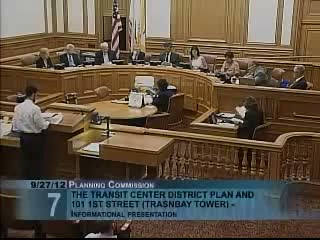
Planning Department staff told the San Francisco Planning Commission on Thursday that the recently adopted Transit Center District Plan and the proposed Transbay Tower require a coordinated update to how the city measures and permits new shadows on Recreation and Park Department properties.
Joshua Switsky, senior planning staff, framed the issue as two linked steps: first, the Planning Commission and Recreation and Park Commission should jointly consider amending the joint 1989 memo that set absolute cumulative limits (ACLs) on new shadows for 14 downtown parks; second, individual projects would continue to be reviewed for whether any new shadow is “adverse” to park use. The department recommended raising some ACLs for seven parks affected by the plan and adopting qualitative criteria tied to how the plan’s EIR modeled shadow profiles.
Switsky highlighted the numbers used in the analysis: the Transit Center District Plan is projected to generate roughly $590 million in net public revenue overall, including about $160 million for new open space and roughly $12.5 million in impact fees available for parks outside the plan area. The staff presentation showed modeled incremental changes to annual sunlight for specific parks — for example, combined plan buildings might increase Justin Herman Plaza’s shaded share by roughly 0.09 percentage points and add about 0.19 percentage points to Union Square’s existing shading — and stressed that many of those increments occur during short morning periods when the sun is low.
Switsky also emphasized qualitative factors not captured by the numeric model: the relative distance of plan-area towers, which tends to diffuse shadows; typical times of day and seasons when new shadows appear; and where within a park the shadow falls. Staff said the Transbay Tower would account for a sizable share of the plan’s modeled new shadow for several parks and recommended that any amendment to ACLs include qualitative criteria — a time-of-day, duration and location profile — so that only projects consistent with the EIR profile could claim budgeted shadow.
Public commenters and several commissioners pushed back, asking whether amending the memo would erode voter protections in Proposition K, which requires the Commission to disapprove projects that cause adverse net new shadows on protected parks. Speakers from community groups urged continued protection of Chinatown parks such as Portsmouth Square and the Chinese Recreation Center.
Commissioners asked staff to provide additional materials at the joint hearing scheduled with the Recreation and Park Commission, including: projected allocations of impact fees; the implementation process (which agencies collect and allocate fees); whether non-RecPark open spaces or sidewalks should be analyzed alongside parks; and whether projects outside the plan area should be considered if they meet the plan EIR profiles. Several commissioners requested that implementation staff and Rec & Park appear at the joint hearing and that the Planning Department prepare supplemental analysis on sidewalks and other downtown open spaces. Staff said a memo and packet materials would be provided before the joint hearing.
At the meeting, commissioners did not take a final vote but agreed to consider the joint amendment at a scheduled joint hearing; staff said the commission will take action on budget revisions only after the joint process and after the qualitative criteria are developed.