Get Full Government Meeting Transcripts, Videos, & Alerts Forever!
Get email alerts on the Land Use And Regulatory topic
No spam. Unsubscribe anytime.
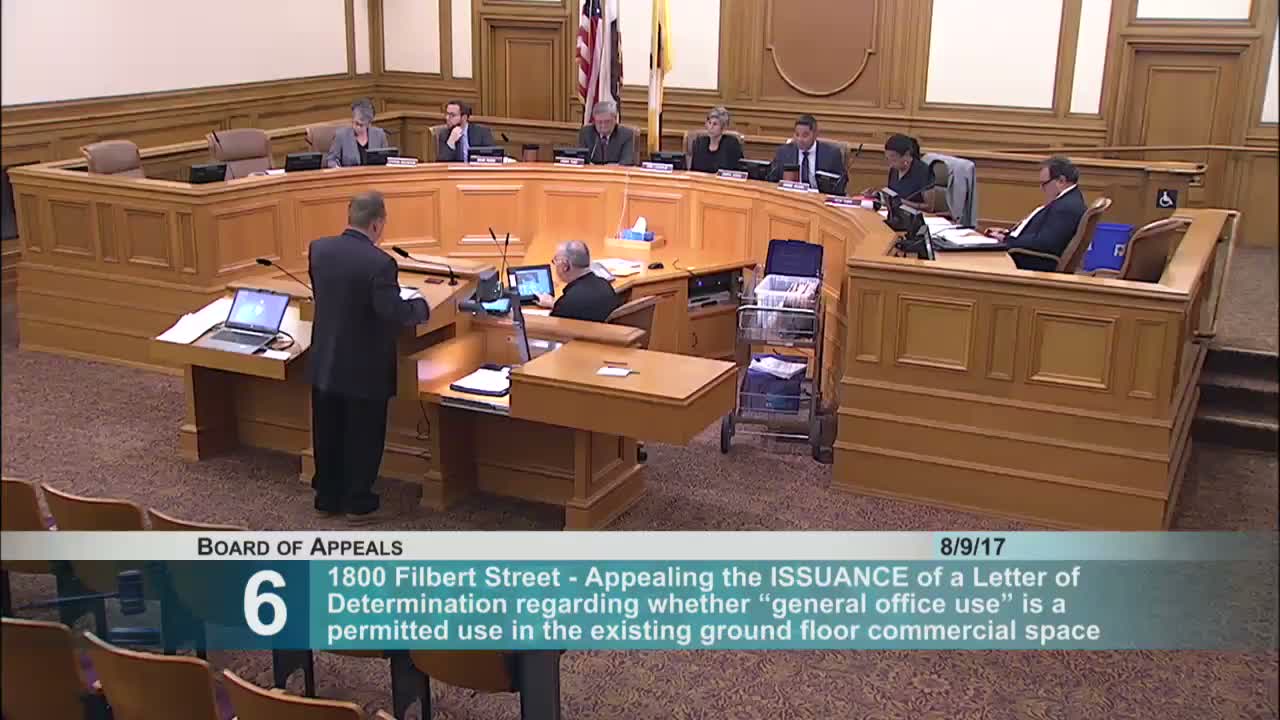
Board rules 1999 permit preserves office use at 1800 Filbert, overturns zoning administrator determination
Summary
On Aug. 9, 2017, the Board of Appeals overturned a zoning administrator's letter of determination and ruled that a 1999 permit authorizing conversion ‘to office’ allowed continued office use at 1800 Filbert, effectively preserving the site's prior office use pending any abandonment determination; board vote 4–1.
The San Francisco Board of Appeals on Aug. 9, 2017, overturned a zoning administrator’s letter of determination that had concluded general office use is not permitted at 1800 Filbert Street and ruled that the 1999 building/permit record (Exhibit B) allowed continued office use on the subject ground‑floor commercial condominium.
Appellants William and Sue Tacoyan, represented by David Silverman, presented a 1999 change‑of‑use building permit signed Sept. 21, 1999, which stated "per plans to convert limited commercial use to office." Silverman argued the owners and successive tenants relied on that permit, investing roughly $60,000 in structural work, and that office use has persisted without a gap suggesting abandonment. The appellants said they lost a prospective tenant (a Lindamood Bell reading/tutoring operation) because of a prolonged change‑of‑use notification process and that the Planning Department’s later communications effectively removed a previously accepted use.
Planning staff (Corey Teague) explained the code distinction: "limited commercial uses" (LCU) in residential districts allow certain service‑oriented offices open to the public (financial services, personal services, licensed professionals), while "general office" (inward‑facing office space not serving walk‑in neighborhood trade) is not permitted in LCUs under the code today. Teague said the specific letter of determination asked whether general office is permitted now; the narrow answer was no. He also clarified that the department had not adjudicated whether the site's LCU had been abandoned (the three‑year abandonment rule can apply) and that the 1999 permit text lacked a precise code citation.
Commissioners debated whether the 1999 permit language unambiguously authorized general office use or instead authorized an LCU/service office; some commissioners noted ambiguity in permit language but expressed concern about stripping current tenants and the property owner of longstanding reliance interests. Vice President Frank Fung moved to grant the appeal, finding the zoning administrator erred and that the 1999 site‑specific permit allowed continuation of office use; the board amended the motion to cite Exhibit B (the 1999 permit) and carried it on a 4–1 vote. The board's decision overturned the limited determination in the letter but did not legislate a citywide change in the planning code definitions.
The board left open the question of abandonment or of what uses would be permitted under a fresh permit; planning staff noted that if the LCU had been abandoned the property owner could seek a conditional‑use authorization to reestablish an LCU, and that today's code does not permit general office in LCUs absent legislative change.