Get Full Government Meeting Transcripts, Videos, & Alerts Forever!
Get email alerts on the Entertainment Permit topic
No spam. Unsubscribe anytime.
Board imposes sound and operational conditions on Hue Nightclub after weeks of complaints and police testimony
Summary
After dozens of public commenters and multiple San Francisco Police Department officers described repeated incidents tied to Hue Nightclub, the Board of Appeals approved conditions that limit entertainment hours and require a sound test/attenuation plan verified by the Entertainment Commission; motion carried unanimously July 26.
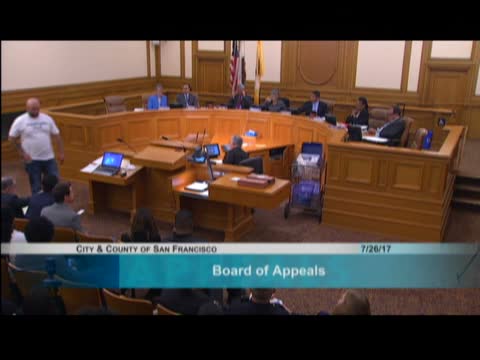
The San Francisco Board of Appeals took action July 26 on an appeal brought by Hue Nightclub (447 Broadway) challenging Entertainment Commission conditions that limited live entertainment to midnight and added other restrictions. The hearing drew extensive public comment for and against the club and lengthy testimony from police and entertainment regulators over persistent neighborhood complaints.
Owner Bennett Montoya and counsel Mark Rennie urged the board to overturn the Entertainment Commission’s action, saying the club had been singled out and that the incident records and CAD calls were overstated. Montoya said he and his staff track sound and maintain documentation and warned that an entertainment cutoff at midnight would "kill our business in 90 days." "Forcing the condition of no live entertainment after 12AM will kill our business in 90 days," Montoya said.
Entertainment Commission staff Maggie Wieland and multiple SFPD witnesses, including Officer Steve Mathias and Commander David Lazar, described a record of calls for service, fights, and incidents outside the venue and argued the Commission’s time, security and sound conditions were reasonable and focused on public-safety protection. Commander Lazar said that, based on police records and the club’s history, the department supported revocation as a last resort and would not oppose stricter enforcement.
Hundreds of speakers and dozens who signed speaker cards addressed the board: some neighborhood residents said the club’s operations blocked alley access, produced a "thumping" bass noise that disrupted sleep, and caused safety problems for children; many supporters and nightlife workers argued Hue provides a rare, diverse venue for people of color and that the Commission’s condition was disproportionate.
After public comment and extensive cross-examination, Commissioner Anne Lazarus moved a compromise motion: grant the appeal in part and adopt conditions (similar to the Entertainment Commission’s conditions) requiring (1) a limitation on live-entertainment hours as adopted by the Entertainment Commission, (2) implementation of the listed security and staffing changes, (3) that the licensee inform neighbors of a sound-attenuation plan, and (4) a mandatory third-party sound test and a requirement that the licensee work with the Entertainment Commission to verify a designated ambient-based sound level and implement attenuation measures to meet that standard. The board voted to carry the motion unanimously.
The board’s action requires the permit holder to work with the Entertainment Commission on a sound test to establish ambient levels and to implement attenuation measures so the venue’s sound does not exceed the verified ambient-derived standard. The Commission will review compliance at a later date per the conditions imposed.