Get Full Government Meeting Transcripts, Videos, & Alerts Forever!
Get email alerts on the Medical Cannabis topic
No spam. Unsubscribe anytime.
Board splits on Bayshore dispensary appeals; building permit left in place by operation of law
Summary
Residents appealed a May 5, 2017 building permit for a proposed medical cannabis dispensary at 2442 Bayshore Boulevard, arguing it sits within 1,000 feet of youth-serving facilities and that petition signatures were forged. After broad public comment and divided commissioner debate, no motion to overturn the permit gained a majority; the permit therefore remains in effect by operation of law.
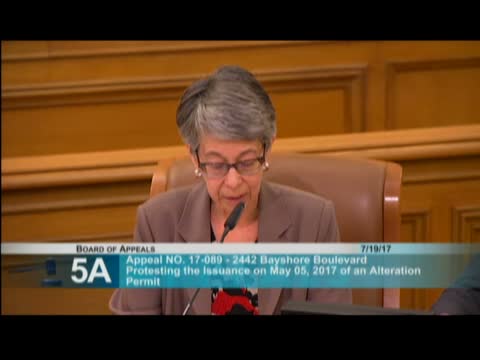
The San Francisco Board of Appeals heard two appeals on July 19 challenging a building permit issued to Elevated Systems Inc. for 2442 Bayshore Boulevard, a proposed medical cannabis dispensary, but the board left the permit in place by operation of law after commissioners failed to achieve a majority to overturn the permit.
Appellants, led by attorney Theresa Lee and the San Francisco Community Empowerment Center, argued the dispensary is within 1,000 feet of several child‑oriented facilities — including the Rock (73 Leland) and the Cross Cultural Family Center (50 Raymond) — and therefore prohibited under the city’s planning code (citing Planning Code §790.141 and related sections). Lee said she submitted recent declarations from program directors that, she said, show these nearby locations primarily serve children, and she urged the board to rescind the permit.
Appellants also challenged the integrity of neighborhood support submitted by the applicant: Lee told commissioners that the applicant submitted roughly 676 signatures purporting to show community backing but that a handwriting expert’s review and address checks indicated many were not genuine and that at least 67 listed addresses did not exist. The appellants argued that mischaracterizing community support and submitting materially false documents could violate the San Francisco Health Code and be grounds to rescind the permit.
Counsel for Elevated Systems responded that planning had properly evaluated the nearby uses and issued a letter of determination finding no prohibitive uses within the 1,000‑foot threshold. The company’s attorney said only a small portion of petition pages were flagged in the handwriting expert’s sample out of a larger packet, argued no showing of material ill intent and emphasized commitments by the operator to invest in the neighborhood — including an asserted pledge to contribute $50,000 a year to community programs and hire locally (the respondent said the dispensary would employ about 12 staff and maintain two security officers on site during business hours).
Zoning Administrator Scott Sanchez described the planning determination process and said his office examined websites, calendars and, where necessary, direct contacts with organizations to decide whether a facility ‘‘primarily serves’’ those under 18. For the facilities cited, Sanchez said planning’s current information indicated those locations do not primarily serve youth on a day‑to‑day basis (for example, he described 73 Leland as functioning primarily as an office site and said youth programming at that address was intermittent). He noted that a state statute’s 600‑foot school setback is distinct from the city’s 1,000‑foot community‑facility rule and reiterated that this was a de novo hearing for the board.
Public comment was extensive and sharply divided. Supporters told the board Elevated Systems would bring jobs, security and neighborhood reinvestment and credited dispensaries with providing community donations and services; speakers included long‑time residents and representatives of violence‑prevention and community organizations. Opponents, including neighborhood residents and community advocates, argued the site sits near multiple child‑serving programs, criticized the applicant’s outreach practices and questioned the validity and provenance of petition signatures.
Commissioners deliberated at length about legal standards and community impacts and probed whether voluntary promises of community contributions can be legally conditioned on a permit. One commissioner said the code’s ‘‘primarily serving’’ standard is imperfect and noted past decisions where the Board had applied community impact considerations beyond a strict zoning determination.
A motion to grant the appeal and deny the permit did not secure the required board majority. A later motion to deny the appeal and affirm the permit likewise failed to receive a majority. With no further successful motions, the board left the building permit intact by operation of law. Board members noted that if the commission later exercises its authority to adopt a contrary decision, it should prepare written findings to support that result.
Next steps: the building permit remains effective; the operator still needs any required Department of Public Health approvals and must comply with conditions tied to operating an MCD. The record shows heightened neighborhood division and requests for clearer, enforceable community‑benefit commitments and for more precise guidance on counting and vetting community petitions.