Get Full Government Meeting Transcripts, Videos, & Alerts Forever!
Get email alerts on the Urban Forestry topic
No spam. Unsubscribe anytime.
Board upholds tree‑removal permit at 75 Howard Street, conditions replacements and in‑lieu payment
Summary
The Board of Appeals approved a Public Works tree‑removal permit for 75 Howard Street with conditions requiring five 48‑inch replacement trees adjacent to the site, a planting application for four additional trees across Stewart Street, and payment equivalent to 12 in‑lieu trees.
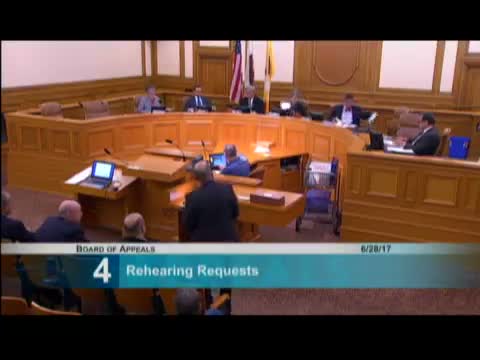
The San Francisco Board of Appeals on June 28 upheld a tree‑removal permit for the 75 Howard Street development but imposed conditions intended to preserve canopy and require mitigation. The board’s motion, made by Commissioner Anne Lazarus, conditions the permit on five 48‑inch‑box replacement street trees adjacent to the property, submission of a planting application for four additional 48‑inch‑box street trees on San Francisco Public Works property across Stewart Street, and an in‑lieu payment equivalent to 12 trees.
Project counsel told the board the site contains 10 existing street trees (five on Howard and five on Stewart) and that significant underground utilities — including a PG&E network vault — plus required clearances would prevent retaining all 10. Architect Mark Schwetman described the constraints from the vault, required street‑light clearances and a high water table that limit where large tree boxes can be placed. Chris Buck, Urban Forester with Public Works, testified he inspected the site, found several Stewart Street ficus in poor structural condition that meet his removal criteria, and identified four plantable sites across Stewart Street with no underground conflicts where replacement trees could be installed.
Appellant David Osgood argued the board’s prior direction had been to preserve canopy volume rather than merely count replacements; he told the board the sponsor’s diagrams did not demonstrate how canopy volume would be maintained. Project counsel and DPW staff responded that the sponsor committed to plant nine on‑the‑ground trees (five adjacent, four across the street), to use 48‑inch boxes where feasible, and to pay additional in‑lieu fees to compensate for trees that cannot be planted directly adjacent to the site. Counsel said the sponsor voluntarily offered to pay for the equivalent of 12 trees to show good faith.
After public comments from housing advocates and labor representatives urging approval to avoid delaying housing construction, the board debated enforceability and whether off‑site plantings could be memorialized. DPW staff said a planting application could be required and that Public Works would accept maintenance responsibility once trees were established and watered for three years. The board’s conditions reflect that approach: replacement trees subject to final DPW approval, an in‑lieu payment, and a required planting application for trees on DPW property.
The roll call on Commissioner Lazarus’s motion recorded the motion carrying with a recorded vote of 4–2 and one commissioner absent. The permit was thus upheld subject to the specified mitigation and DPW approval of replacement locations.
The board moved on to the next agenda item after the vote.