Get Full Government Meeting Transcripts, Videos, & Alerts Forever!
Get email alerts on the Chinese Hospital Replacement topic
No spam. Unsubscribe anytime.
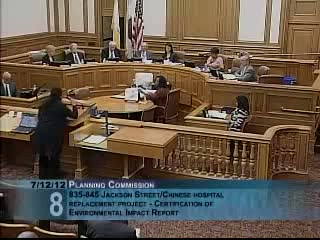
Planning Commission certifies EIR and approves Chinese Hospital replacement with design refinements requested
Summary
After extensive public comment on preservation and programmatic needs, the Planning Commission certified the final EIR for the Chinese Hospital replacement, adopted CEQA findings (with one minor amendment removed), approved a General Plan amendment and rezoning to create a Chinese Hospital Special Use District (110‑G), and authorized the conditional use, while directing continued design work to better reflect Chinatown—s historic character.
The Planning Commission voted unanimously to certify the Final Environmental Impact Report (EIR) and to approve a package of land‑use actions for the Chinese Hospital Replacement Project at 835–845 Jackson Street in Chinatown.
Staff presentation and EIR findings: Planning staff reported that the draft EIR (published 04/16/2012) and the Final EIR identify significant impacts that can be mitigated for cultural/paleontological resources, transportation and noise, while finding that historic resources impacts (demolition of the 1924 Medical Administration Building) and certain air‑quality/health‑risk impacts (PM2.5 and diesel particulate matter) would remain significant and unavoidable. Staff concluded the EIR was legally adequate and that the comments received had been addressed in the comments and responses document.
Public testimony: Public speakers were divided. Preservation advocates (Howard Wong, Sue Lee of the Chinese Historical Society) urged more retained fabric or prominent commemoration of the 1924 building and asked the commission to consider alternatives or salvaging historic features. Supporters, including physicians, community organizations and senior‑care partners (Gordon Chin, Grace Lee and others), emphasized the hospital—s critical role for Chinatown—s largely elderly, Cantonese‑speaking population and said modern space, seismic upgrades and an on‑site skilled nursing component are programmatic necessities.
Project and approvals: Staff and the sponsor, Chinese Hospital (represented by COO Linda Schumacher), described a phased replacement hospital of approximately 100,000 sq ft with 54 acute care beds and a 22‑bed skilled nursing facility, updated operating standards, improved plazas/alleys and a photovoltaic cap. The commission adopted CEQA findings with an agreed amendment removing one proposed overriding consideration related to memorial features; it then approved a General Plan amendment to the Chinatown area plan, rezoned the property to a Chinese Hospital Special Use District (110‑G) with height and bulk adjustments, and granted the conditional use authorization. The commission required the project sponsor to continue working with department staff on building design details and requested an informational presentation on design refinements.
Why it matters: Commissioners balanced the acknowledged unavoidability of some environmental impacts under CEQA with the recognized community need for modern hospital facilities that meet seismic and operational standards. They directed staff and the sponsor to pursue design refinements so the new building better responds to Chinatown—s special historic and urban context while allowing the hospital to proceed in a phased manner that maintains continuous patient care.
Next steps: The project sponsor will continue design work with Planning Department staff to refine facade treatment, pedestrian frontage and plaza details; the commission asked staff to bring an informational update. Certifications and land‑use approvals allow the sponsor to proceed with the approvals process and OSHPD review required for hospital construction and later building permits.