Get Full Government Meeting Transcripts, Videos, & Alerts Forever!
Get email alerts on the Appeal 17 039 Sparc topic
No spam. Unsubscribe anytime.
Board orders more detailed plans and conditions, continues SPARC expansion appeal to July 26
Summary
After extensive public comment and debate over whether a 103-square-foot expansion of SPARC at 473 Haight Street constitutes a "significant intensification," the Board of Appeals continued appeal 17-039 to July 26, 2017 and directed the project sponsor and Planning Department to submit conditions addressing public retail access, monitoring, and related business-plan details.
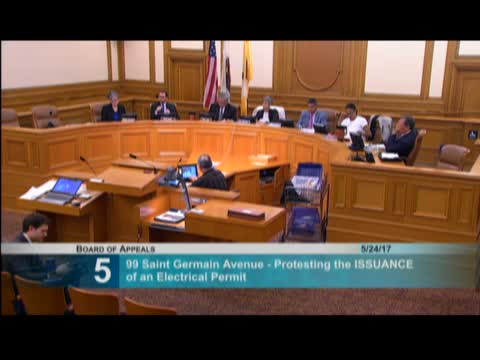
The San Francisco Board of Appeals on May 24, 2017 continued appeal 17-039, a challenge to an alteration permit for SPARC (a medical cannabis dispensary) at 473 Haight Street, to July 26 so the project sponsor and Planning Department can craft clearer conditions and revised plans to address public access and monitoring of the retail and dispensary spaces.
Steve Williams, counsel for the appellant Lower Haight Advocates for Responsible Use of Marijuana, told the board the city is wrongly reading the planning rules as limited to a purely numeric threshold. "The city is completely ignoring the word 'intensification' as it appears in the statute," Williams argued, urging that factors such as increased patrons, traffic, noise and equipment can trigger a conditional-use public hearing even without a large square-foot increase.
Tom Tunney, counsel for SPARC, said the alteration permit authorizes a modest expansion from about 414 square feet to 517 square feet—a 103-square-foot increase roughly the size of a 10-by-10 room—and that the Planning Department, the Planning Commission and this board have previously applied a 25 percent or 500-square-foot threshold. "This rule accounts for the effects of the increase that are cited by appellant," Tunney said, urging denial of the appeal.
Zoning Administrator Scott Sanchez explained the property is a legal nonconforming MCD in an NC-2 district and reiterated that Planning Code section 186.1 treats significant intensification as the trigger for conditional-use review. Sanchez also recommended specific enforcement tools to preserve public retail access if the board sustains the permit, including a Notice of Special Restrictions recorded on the deed and an annual reporting or monitoring condition.
Dozens of residents and stakeholders spoke during public comment. SPARC clients and employees described health and safety benefits: client Daniel Amaral said, "The medication that I get from Spark is really helpful." Neighbors and merchants raised concerns about displacement, contradictory interdepartmental guidance, and whether the front retail area remains truly public. One merchant said rents on the block rose sharply after SPARC opened and blamed a "bidding war" for displacing long-standing businesses.
During rebuttal and staff questioning, the board focused on whether the front portion of the space will remain publicly accessible retail or will effectively be reserved for cardholders. Sanchez confirmed the plans currently show retail at the front but said the Department's expectation was that space would be publicly accessible; he recommended a recorded notice with floor plans and an annual reporting requirement to provide enforceable clarity.
Commissioners debated whether greater popularity or better management alone constitutes unlawful intensification or whether the code's numeric threshold governs. After deliberation, the board voted to continue the matter to July 26, 2017 and directed the project sponsor to work with the Zoning Administrator and Planning Department to produce conditions and revised plans addressing: (1) public access to the retail space; (2) the project sponsor's business plan and operational details; and (3) any monitoring or enforcement language (for example, an annual report and site photographs). The sponsor and appellant were ordered to submit written materials in advance so the board can review them prior to the continued hearing.
The board did not grant revocation of the permit; rather, it left open the ability for the sponsor to reapply or seek conditional-use authorization if the board's concerns are not satisfied.