Get Full Government Meeting Transcripts, Videos, & Alerts Forever!
Get email alerts on the Land Use Development topic
No spam. Unsubscribe anytime.
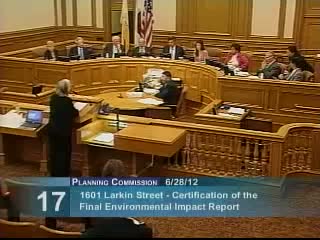
Commission certifies EIR for 1601 Larkin but signals intent to deny project approvals after heated public debate
Summary
After hours of public testimony about demolition‑by‑neglect, preservation alternatives and neighborhood impacts, the Planning Commission certified the final EIR for 1601 Larkin 5–2. Later in the evening the commission voted an 'intent to disapprove' the project (conditional use authorization and variances) and staff/zoning administrator indicated some variances were unlikely to be granted.
A prolonged and often contentious public review of the environmental document and project design for 1601 Larkin Street dominated the Planning Commission’s June 28 hearing. The final Environmental Impact Report (EIR) for the proposed replacement of the historic First St. John’s Methodist Church with a six‑story residential building was certified by the commission on a 5–2 vote after extensive public testimony and discussion of whether the revised EIR required recirculation.
Planning staff summarized the EIR history: a draft circulated in 2007 with a 45‑day comment period, a public hearing on the draft in 2007 and 2010, and revised materials submitted in 2012. Staff concluded the revisions did not add “significant new information” that would require CEQA recirculation; staff nevertheless acknowledged that demolition of the existing church would remain a “significant and unavoidable” impact and that any approval of the project would require the commission to adopt a statement of overriding considerations explaining why project benefits outweigh the unavoidable impact.
Hundreds of pages of public comment were filed and more than three dozen speakers addressed the commission in the hearing’s public‑comment period. Neighborhood and preservation groups urged denial or recirculation, arguing the EIR failed to analyze feasible preservation or partial‑preservation alternatives adequately and that the church had been allowed to deteriorate through alleged demolition‑by‑neglect. Speakers cited past hearings, subpoena activity, and litigation tied to the project sponsor. Preservation advocates asked the commission to examine rehabilitation options more carefully and to weigh the precedent of allowing demolition where a building could be adaptively reused.
Church representatives, the United Methodist Conference, clergy and several neighbors urged certification and project approval to remove an ongoing blight that they said had become a homeless encampment and a safety problem. Supporters said redevelopment would bring new residents, increased local spending and site security.
Following the EIR certification, the commission considered project approvals (conditional use authorization for height above 40 feet, variances for rear‑yard and other exceptions). Commissioners debated whether the project satisfied the “necessary and desirable” standard for approvals above the 40‑foot threshold, whether the EIR’s project objectives were appropriate for alternative comparison, and what compensating community benefits — such as on‑site below‑market-rate units, increased in‑lieu contributions, car‑share spaces or a neighborhood meeting room — could justify an exception that results in demolition of a historic resource.
After extended deliberation, the commission voted to direct staff and city attorneys to prepare findings for an intent to disapprove the project (vote recorded as 6–1). The zoning administrator stated he was disinclined to grant the variances because the five findings required for variances had not been met. The commission’s actions mean the EIR is certified (allowing the record of environmental review to be complete) but project approvals remain contested; staff will prepare denial findings and the project sponsor may revise materials or appeal variances as allowed under code.
The hearing record shows substantial neighborhood division: some residents supported the project as a route to eliminate blight and increase housing; preservation groups, neighborhood associations and many immediate neighbors asked the commission to protect historic fabric and require a smaller, more contextual alternative or full adaptive reuse.