Get Full Government Meeting Transcripts, Videos, & Alerts Forever!
Get email alerts on the Economic Development topic
No spam. Unsubscribe anytime.
City unveils Central Market economic strategy aimed at reducing vacancies and preserving neighborhood mix
Summary
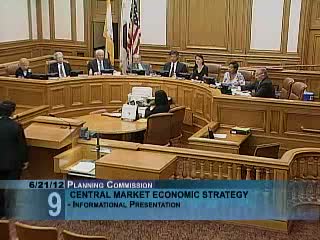
The Office of Economic and Workforce Development presented the Central Market Economic Strategy, a multi‑agency action plan to stabilize the Central Market district. Goals include preventing displacement, reducing vacancies and building an arts‑oriented creative cluster; staff highlighted tax incentives, loan funds and a proposed infrastructure financing approach.
City staff from the Office of Economic and Workforce Development presented the Central Market Economic Strategy, an action plan assembled with multiple agencies and community partners to stabilize and revitalize the Central Market corridor roughly bounded by Fifth to Tenth streets along Market.
Jordan Klein (OEWD) characterized the strategy as a cross‑departmental approach that leverages incentives—such as the payroll tax exclusion for net new jobs—and targeted programs including a dedicated loan fund, parking and public‑realm improvements. Klein said recent technology leasing activity amounts to roughly 400,000 square feet of new office leases and about 1,800 new jobs in the near term, with a projection to increase to more than 3,800 jobs in coming years.
The plan sets six objectives: stabilize existing residents, enhance and activate the public realm, establish a creative‑arts community, reduce vacancies, build community capacity, and improve safety. Priority planning actions include adaptive reuse of long‑vacant historic buildings, protecting arts uses from displacement, implementing Better Market Street elements, and exploring an infrastructure finance district to pay for public improvements.
Public commenters emphasized the need to protect low‑income residents and ensure that any incentives and tax tools also fund affordable housing and transit. Commissioners asked for ongoing updates about community benefits agreements tied to companies taking payroll tax exclusions; staff said the City Administrator’s office will negotiate CBAs with qualifying firms and release a fact sheet soon. The presentation was informational; staff said implementation is already supported in the mayor’s proposed budget with funds for Central Market revitalization in 2012–14.