Get Full Government Meeting Transcripts, Videos, & Alerts Forever!
Get email alerts on the Wireless Telecommunications topic
No spam. Unsubscribe anytime.
Planning commission approves AT&T rooftop antennas at Noriega Street despite neighbors’ health concerns
Summary
The Planning Commission voted to approve a conditional use permit for AT&T to install up to 11 rooftop panel antennas at 2543 Noriega Street. Neighbors cited health and aesthetic concerns; planning staff and the Department of Public Health said RF levels meet FCC guidance. The approval included conditions and community‑liaison commitments by AT&T.
The Planning Commission approved a conditional use permit allowing AT&T to install up to 11 rooftop panel antennas and associated equipment at 2543 Noriega Street, a two‑story commercial building in an NC‑2 neighborhood commercial district. Planning staff recommended approval with conditions after the Department of Public Health reviewed the radio‑frequency (RF) report and found the proposal complies with current Federal Communications Commission guidelines.
Adrian Putra of the planning department described the project as a co‑location on a preference‑2 site that would screen most antennas behind the parapet or hide them in faux vents, with associated cabinets located inside the building’s ground‑floor equipment room. “The Department of Public Health has reviewed the RF report … and determined that the proposal complies with current FCC guidelines,” Putra said during the hearing.
AT&T external affairs representative Teddy Verhaiz said the carrier analyzed 33 alternative sites and selected the Noriega address to close a coverage gap. Verhaiz also told the commission AT&T will extend its testing and outreach beyond the 205‑foot regulatory measurement zone when residents express RF concerns and will provide a community liaison and on‑site measurements on request.
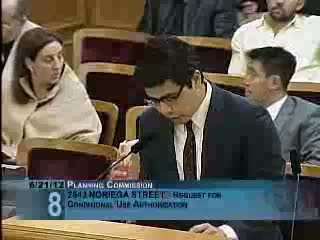
Nearby residents who live across from the building urged the commission to deny the permit, citing petitions, physician letters and nonpeer‑reviewed studies about RF and cancer risk. Joseph Raymond, a resident who said he lives across the street, said he brought a petition of roughly 30 neighbors opposed to the antennas and warned about health risks to children and the elderly.
Commissioners pressed staff and AT&T on two recurring concerns: visual impact and the city’s limited authority to regulate health issues that are inside federal guidance. Commissioner Sugaya asked staff to “explain the radiation part of this whole thing,” and Putra said DPH is the lead agency for emissions review and the commission cannot deny a project that meets FCC standards. Commissioner Antonini added that the drawings show most antennas will be screened and therefore have minimal aesthetic impact.
Commissioner Antonini moved approval with conditions citing required screening and nondiscrimination among carriers; the motion passed unanimously. The approval included standard conditions and the requirement that AT&T provide a public contact for post‑installation measurements and follow‑up.
The project record includes seven correspondences and a 36‑signature petition in opposition. AT&T agreed to take contact details from concerned residents and to arrange site‑specific testing through its engineering consultants.