Get Full Government Meeting Transcripts, Videos, & Alerts Forever!
Get email alerts on the Wireless Permits topic
No spam. Unsubscribe anytime.
Board denies rehearing request over wireless facility permit at 1590 Sacramento Street
Summary
The San Francisco Board of Appeals rejected a rehearing request from Mitchell Kemp challenging a wireless facility permit (Extonant/Verizon), finding no new material facts and confirming that public RF testing is handled through permit-holder arrangements with DPW/DPH.
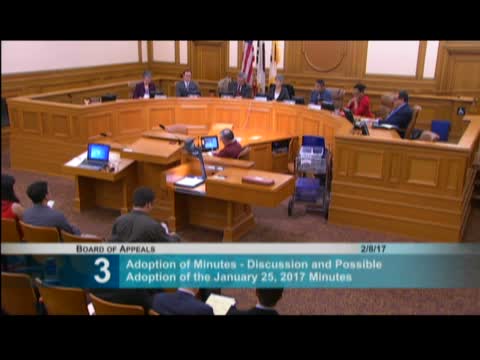
The San Francisco Board of Appeals on Feb. 8 denied a rehearing request from Mitchell Kemp challenging a wireless-facility permit for 1590 Sacramento Street, concluding the appellant did not present new, material facts meeting the high standard for rehearing.
Kemp asked the board to reopen appeal 16-092, saying he had late-arriving information about permit Condition 4 and that there was “no operational monitoring, control, inspection, and no recourse for a citizen” during the facility’s operational life. He said residents were told to contact the permit-holder’s contractor rather than city agencies and sought clearer, enforceable procedures.
Outside counsel Paul Albritton, representing the permit holder, said no new or material information had emerged and described how members of the public can request RF measurements: the permit holder (or its contractor) arranges a visit with a professional to take readings inside a residence when requested. Albritton said the facilities operate at extremely low levels and that the mechanism described in Condition 4 has been used for other carriers.
Amanda Higgins of the Department of Public Works told the board Condition 4 means the permit holder (XNET/Extonant) should visit residents and take in-home radio-frequency readings upon request and that the requirement is a process (a technique or system) rather than a physical device. She also said the permit requires submittal of a verified engineer’s statement within 30 business days of installation and a verified statement at renewal; wireless permits issued under Article 25 have a 10-year term and may receive a one-year extension. Higgins said Public Works will issue notices of deficiency and can revoke permits that fail to comply.
After questions from board members about which city departments handle requests and how follow-up is enforced, Vice President Frank Fung moved to deny the rehearing. The board voted unanimously to deny the rehearing request, finding no manifest injustice and no new factual basis for reopening the matter.
The denial leaves in place the earlier determination that the permit was properly issued. The Board recorded that residents may request RF testing and that testing is to be carried out by a professional engineer or contractor working with the permit holder, with DPW and, where appropriate, the Department of Public Health involved in review and follow-up.