Get Full Government Meeting Transcripts, Videos, & Alerts Forever!
Get email alerts on the Transit Center Eir topic
No spam. Unsubscribe anytime.
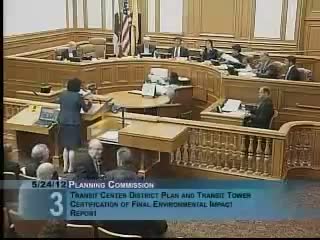
Planning Commission certifies Transbay Transit Center EIR amid heated shadow debate
Summary
The San Francisco Planning Commission certified the final environmental impact report for the Transit Center District Plan and Transit Tower after extensive debate over shadow impacts and Proposition K. The certification passed 4–1; commissioners also adopted related CEQA findings and plan actions.
The San Francisco Planning Commission on May 24 certified the final environmental impact report (EIR) for the Transit Center District Plan and Transit Tower, clearing the way for subsequent entitlement steps while stopping short of approving the tower project itself. The commission voted 4–1 to certify the EIR, with Commissioner Catherine Moore the lone no vote.
Sarah Jones, senior environmental planner for the department, told the commission the document is both programmatic for the district and project-level for the transit tower; it was circulated as a draft on Sept. 28, 2011, with a public hearing on Nov. 3 and a comment period that closed Nov. 28. Jones said the EIR analyzes a “worst case scenario” for shadow impacts, recognizes significant unavoidable impacts across multiple areas (visual resources, cultural resources, transportation, noise, air quality and shadow), and includes three alternatives — no project, a reduced-project alternative and a reduced-shadow alternative. She stressed that “CEQA does not require that a project be code compliant in order for the EIR to be certified,” noting certification is an informational finding on impacts, not an approval of entitlements.
Public speakers and several commissioners raised sharp objections focused on shadow impacts and compliance with Proposition K (Planning Code section 2.95). Bill Maher and Sue Hester, among others, urged the commission to require code compliance and to amend the EIR or withhold certification where the EIR showed shadowing beyond limits set under Prop K. City Attorney John Malamet and staff explained that the Prop K process and any specific shadow allocations are typically triggered at the time a specific building permit or project-level review is before the commissions; Malamet said the implementation memo that contains shadow budgets was adopted jointly by the Planning and Rec & Park commissions and that those criteria can be adjusted by the commissions in the future.
Commissioner discussion centered on whether shadow impacts should be evaluated building-by-building or cumulatively; staff noted the Park Shadow Task Force has recommended the two commissions later review cumulative shadow data for plan-area projects so that decisions on shadow allowances can be made with context. Commissioners also debated whether alternatives that would avoid any shadowing were feasible under CEQA; staff and the city attorney said a downzoning that eliminated shadowing would be a different project that would not meet many project objectives and therefore was not a feasible alternative.
After discussion, Commissioner Mike Antonini moved to certify the final EIR. The motion passed on a roll-call vote with Antonini, Borden, Wu and Phan voting yes and Commissioner Moore voting no. Commissioners later adopted the CEQA findings, including a statement of overriding considerations, on a separate motion that passed 5–1.
What happens next: certification allows the EIR to serve as the environmental record for later entitlement actions but does not amount to approval of the transit tower or any changes to shadow allocations under Prop K. Future approvals that would authorize specific shadow allocations or code exceptions will require separate hearings and, where applicable, joint consideration with the Recreation and Park Commission.
Votes and formal actions at a glance: the EIR certification motion passed 4–1; commissioners later adopted CEQA findings and mitigation/monitoring documents (vote 5–1). Several linked adoption actions on general-plan and code changes were also considered the same day (see related coverage).