Get Full Government Meeting Transcripts, Videos, & Alerts Forever!
Get email alerts on the Historic Preservation topic
No spam. Unsubscribe anytime.
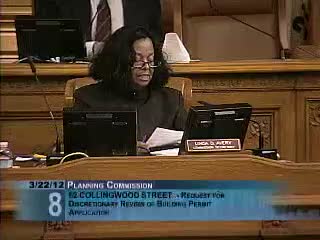
Commission affirms Planning staff: 62 Collingwood replacement windows allowed
Summary
After a contested appeal from a neighbor who sought historic wood windows, the Planning Commission voted to accept staff findings and not take discretionary review, keeping the owner’s 2007 aluminum‑clad, triple‑pane Marvin windows in place as appropriate for the block face.
The Planning Commission voted unanimously on March 22 not to take discretionary review and to allow the replacement windows installed at 62 Collingwood Street, siding with the Planning Department’s Residential Design Team and preservation staff assessments.
The dispute arose after owner Beth Lieber installed triple‑pane, aluminum‑clad Marvin windows in November 2007 to reduce street noise. A neighbor, Alan Burredell, argued that the building—an Edwardian structure visible from the sidewalk—should be restored with historically accurate wood double‑hung windows and appealed on that basis. Burredell and many neighbors cited the Planning Department’s guidance that street‑facing windows on period buildings should match original size, profiles and finish.
Lieber said she was unaware a permit was required when the windows were installed in 2007, obtained an over‑the‑counter correction permit in 2011 after being contacted by neighbors, and argued the windows are an improvement over the prior single‑pane aluminum frames. She noted that the windows are triple‑pane and were professionally installed; she provided documentation that the Residential Design Team and preservation staff reviewed the windows and found them appropriate for the block face.
Supporters of wood windows presented multiple letters and spoke about consistent application of standards on the block. Supporters of the installed Marvin windows included architects and a window dealer who said modern aluminum‑clad thermally improved products are often approved and can match historic profiles closely.
After hearing lengthy arguments on both sides and technical input from planning staff and preservation staff, the commission accepted staff’s recommendation not to take discretionary review and to approve the installed windows. Commissioners noted the department’s review and suggested clearer outreach on window‑replacement guidance for owners and contractors.
Next steps: the decision can be appealed to the Board of Appeals; planning staff indicated the Board of Appeals had already been engaged in related procedural aspects and that appeals will follow the normal process.