Get Full Government Meeting Transcripts, Videos, & Alerts Forever!
Get email alerts on the Land Use Development topic
No spam. Unsubscribe anytime.
Planning commission certifies final EIR and approves entitlements for 8 Washington project in 4–2 votes
Summary
After hours of testimony for and against the waterfront scheme, the Planning Commission certified the final environmental impact report for the 8 Washington Street proposal and approved related entitlements — including a newly established cumulative shadow limit for Sue Bierman Park — in 4–2 votes. Opponents voiced concerns about lost outdoor recreation, shadows, and height; supporters cited open space, jobs and city revenue.
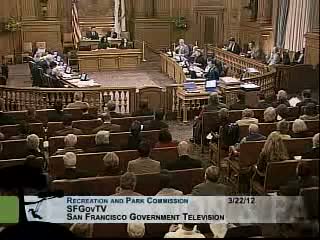
The San Francisco Planning Commission voted on March 22 to certify the final environmental impact report (EIR) for the 8 Washington Street waterfront project and approve a package of entitlements for the proposal, including a planned unit development, zoning and general‑plan amendments and conditional‑use authorization. The actions passed on several 4–2 votes after a joint hearing with the Recreation and Park Commission that lasted most of the day.
Staff described the certification as an action on the EIR only, not a project approval. Paul Malcher of the Planning Department told commissioners the EIR is “an informational document” intended to disclose potential impacts and mitigation options and that recirculation would be required only if the EIR identified new or substantially more severe impacts. Lisa Beyer of the Recreation and Park Department presented a numerical analysis of shadow impacts on Sue Bierman Park and recommended establishing an absolute cumulative shadow limit of 4,425 square‑foot hours (about 0.00067 percent of the park's theoretical annual sunlight) and allocating that limit to the project.
Supporters and opponents filled the hearing room for hours of public comment. Opponents — including longtime Golden Gateway residents and the neighborhood group Friends of Golden Gateway — said the EIR understates impacts to recreation and neighborhood character, and warned the proposal would result in the permanent loss of outdoor tennis courts and open‑air recreation used by children and seniors. “Turn the EIR down for gross insufficiencies,” a representative of Friends of Golden Gateway told commissioners during public comment, arguing for additional analysis and alternatives.
Supporters — including labor unions, the Ferry Plaza Farmers Market leadership, neighborhood organizations and several architects — urged approval, saying the project replaces an underused surface parking lot and a fence‑enclosed club with publicly accessible open space, consolidated parking to support Ferry Building businesses, new pedestrian connections and a renovated aquatic and recreation facility. Several housing advocates and affordable‑housing developers told the commission the in‑lieu fee proposed for affordable housing could be leveraged to produce units elsewhere in the city at a time when funding sources are scarce.
On technical points, Recreation and Park staff said the new shadow would occur only for short periods in June and July near dawn and dusk and would fall on park areas that staff identified as having no benches or other fixed seating. The staff presentation included precise figures for existing and projected annual sunlight availability and for specific minutes of new net shadowing on June 21 and June 28. Planning staff and the sponsor also addressed questions about construction truck trips, pile driving, traffic queuing at garage entries, and sea‑level rise; the project team said those matters had been analyzed in the EIR and the comments‑and‑responses volume.
Votes and next steps - The Planning Commission certified the final EIR and adopted CEQA findings by a 4–2 vote, with Commissioners Seguaya and Wu voting no. Commissioners who voted in favor said the EIR met CEQA’s informational standard, and that the public benefits and mitigation measures supported certification. Commissioners voting no said outstanding concerns about cumulative and aesthetic impacts remained.
- The two commissions jointly established an absolute cumulative shadow limit for Sue Bierman Park and the Recreation and Park Commission recommended the Planning Commission find the project’s net new shadow would not be adverse; both actions passed with the same 4–2 split.
- The commission also recommended general‑plan map changes, approved planned‑unit‑development modifications and conditional‑use authorizations, and voted to reclassify two portions of the site’s height‑and‑bulk districts — each by 4–2 margins. Those actions will be part of the ongoing entitlement process that includes subsequent consideration by the Board of Supervisors where applicable.
Why it matters The site, which combines Port‑owned Seawall Lot 351 and adjacent private parcels, sits at a key seam between downtown and the waterfront. Supporters say the project will reconnect neighborhoods to the Embarcadero, deliver publicly accessible parks, and generate revenue and infrastructure funding for the Port and city. Opponents say the project gives away public goods, sets a precedent for future upzoning along the waterfront, and permanently removes outdoor recreation used by families and seniors. The project’s opponents and proponents both pointed to the same EIR and neighborhood studies but read the implications differently.
What comes next The Planning Commission’s votes clear key local approvals but do not by themselves finish the process. Zoning reclassifications and some general‑plan amendments require action by other city bodies; the Board of Supervisors or other city decision‑makers will consider those items as part of the subsequent approval track. Legal challenges and appeals are also possible given the divided votes and extensive public opposition during the hearing.
A note on sources and attribution: this article cites testimony and presentations made at the joint Planning and Recreation & Park Commission hearing on March 22, 2012, including staff presentations by Paul Malcher and Lisa Beyer and project sponsor presentations by representatives of San Francisco Waterfront Partners and the Port of San Francisco. Direct quotes and numeric figures are drawn from speakers’ statements presented in the hearing record.