Get Full Government Meeting Transcripts, Videos, & Alerts Forever!
Get email alerts on the Retail Grocery Formula topic
No spam. Unsubscribe anytime.
Planning Commission approves Fresh & Easy in the Mission with conditions after heated public debate
Summary
After extensive public testimony on alcohol sales, WIC participation and local hiring, the San Francisco Planning Commission approved a conditional-use permit for Fresh & Easy to open a grocery at 1245 South Van Ness, imposing conditions including beer-and-wine sales only, staffed alcohol checkout, WIC application when permitted, and a local-hire partnership and one-year reporting requirement.
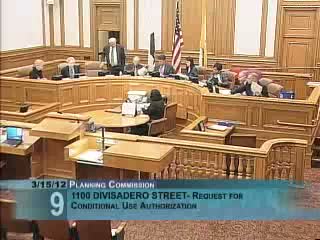
The San Francisco Planning Commission on a 4'to—3 vote approved a conditional-use authorization for Fresh & Easy Neighborhood Markets to open a 16,241-square-foot grocery at 1245 South Van Ness, a heavily contested site in the Mission District.
The decision followed a full-day hearing in which staff described the proposal as a reestablishment of grocery use on a site occupied by a supermarket since 1959 and recommended approval with conditions. Planning staff said the project will reconfigure the lot, provide bicycle parking and landscaping, and pay approximately $530,000 in impact fees tied to jobs, housing linkage and transit mitigation.
Residents and community groups gave the hearing its length and heat. Opponents told the commission they feared Fresh & Easy's assisted/self-checkout model would make alcohol easier for underage buyers, that the chain's past behavior raised doubts about promises on WIC and worker rights, and that the formula-retail nature of the chain threatened small, independent neighborhood grocers. Lisa Duncan, representing a community coalition, said the project relied on a transferred liquor license and cited city code she said barred such a transfer after a 30-day abandonment period. Alcohol-justice advocates and clergy urged stronger local controls and delay until state-level AB 183 litigation is resolved.
Company representatives and supporters, including the property owner and several neighborhood nonprofits, said Fresh & Easy would restore grocery service to a long-vacant storefront, add bicycle parking and landscaping, sublet space to community services in negotiation, and pursue local hiring. Fresh & Easy told the commission it intends to hire locally, partner with community groups such as Arriba Juntos, and operate assisted checkout procedures that lock and alert staff whenever alcohol is scanned.
To bridge the neighborhood's concerns, the commission added and approved these conditions: require the operator to continue and document its partnership with a local hiring intermediary (Arriba Juntos or equivalent) and report back to the commission in one year about hiring outcomes; require that, once the state's moratoriums and eligibility rules permit, the operator apply for participation in the WIC program; limit alcohol sales at the site to beer and wine; require that alcohol purchases be completed at a staffed checkout or by an employee who completes the transaction after an assisted-checkout alert (so alcohol cannot be completed solely via self-checkout); and name the on-site store manager as the community liaison for neighborhood concerns.
The commission acknowledged the state-level litigation over AB 183 and noted that enforcement of state alcohol rules rests with the Department of Alcoholic Beverage Control; local conditions cannot pre-empt state law. Commissioners also debated how far the planning process could require or enforce hiring goals; the approval ties the operator to active partnership and follow-up reporting rather than a rigid quota.
The operator and community groups will now implement the conditions and monitor outcomes; the commission set the one-year progress report as the next procedural check point.