Get Full Government Meeting Transcripts, Videos, & Alerts Forever!
Get email alerts on the Transportation Planning topic
No spam. Unsubscribe anytime.
SFMTA, Planning Department outline Eastern Neighborhoods transport plan prioritizing 16th, Folsom–Howard and 7th–8th corridors
Summary
SFMTA presented the Eastern Neighborhoods Transportation Implementation Study, prioritizing 16th Street, Folsom–Howard and 7th–8th corridors with recommended transit-first designs, protected cycle tracks and sidewalk widenings. Staff warned of significant utility-driven costs and funding gaps and said projects will move into environmental review.
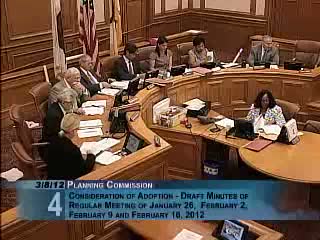
Tim Papandreou, SFMTA deputy director of planning, gave the San Francisco Planning Commission an overview of the Eastern Neighborhoods Transportation Implementation Study on March 8, outlining project concepts for three prioritized corridor groups and next steps toward environmental review.
"We went through an extensive prioritization process where we narrowed down three major corridors of focus," Papandreou said, describing 16th Street, the Folsom–Howard pair and the 7th–8th couplet. He said the team favored a transit-first approach on 16th Street, proposing a center-median transitway with boarding islands and traffic-calming measures similar to bus rapid transit.
The study’s recommendations include protected cycle tracks (described as grade-separated or physically protected bicycle lanes), bus boarding islands, selective sidewalk widenings and measures to shorten pedestrian crossing distances. Papandreou said implementing the concepts would require some removal of on-street parking: "I'm not gonna shy away from that," he said, noting right-of-way constraints.
Commissioners pressed staff on trade-offs and costs. The presentation gave rough order-of-magnitude estimates: up to $53 million for a full Folsom–Howard rebuild depending on the option chosen; about $32 million for a three-lane design on 7th–8th with widened sidewalks and protected cycle facilities; and $500,000–$800,000 for an interim 'road diet' pilot using striping and signal changes. Papandreou warned that utility relocations, stormwater work and signals drive much of the cost: "Signals cost $150,000 each," he said, noting intersection work can be hundreds of thousands of dollars.
Commissioners urged prioritizing pedestrian safety and phasing work. Commissioner Borden called the $53 million figure "sticker shock" and suggested phasing. Commissioner Bridal asked for clarification on "cycle track" versus a bicycle lane; Papandreou replied cycle tracks are protected facilities, often grade separated or physically delineated from vehicular lanes.
Staff said the next step is to write project descriptions and carry the most-advanced alternatives into the environmental phase. Papandreou said the project cost estimates are being placed into the MTA capital improvement plan and that staff will pursue development agreement contributions and other funding sources to close an anticipated gap.
The Planning Commission did not vote on the study; commissioners indicated the commission would review project descriptions during the environmental review stage and that the commission would be the approving body for finalized project designs.
What happens next: staff will refine the corridor project descriptions for environmental analysis and return to the commission when the projects are ready for formal review and potential approval.