Get Full Government Meeting Transcripts, Videos, & Alerts Forever!
Get email alerts on the Zoning Office Use topic
No spam. Unsubscribe anytime.
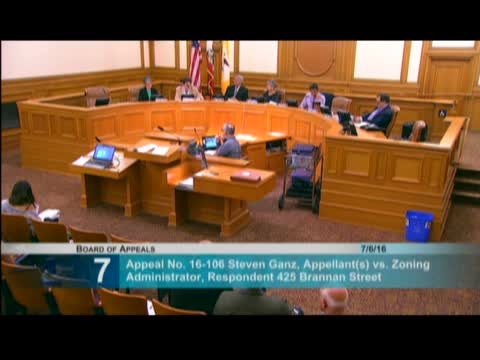
Board hears appeal over whether second floor at 425 Brandon Street is legal office use under SLI zoning
Summary
Property owner Stephen Gans argued for decades-long office use at 425 Brandon Street and cited permit history and prior tenants including SF Weekly and the District Attorney; Planning Department staff told the board it could not locate permits authorizing general office use and categorized earlier tenancies as business service. The board voted to continue the item to allow the absent commissioner to participate.
Stephen Gans, representing First California Investments, told the San Francisco Board of Appeals on July 6 that the second floor at 425 Brandon Street has functioned as office space for decades and that historical permits and tenancy demonstrate it was a legal office use prior to rezoning. "We have always understood that it was the central permits bureau role to at least point out if there was a potential issue with the uses listed on the permit and then route us to planning," Gans said, arguing that the property's permit record and a 1987 transit impact development fee (TIDF) list show the space was treated as office use.
The conflict centers on whether the second floor is a legal general office use after the area's 1990 rezoning to the SLI (South of Market light industrial) district, which limits general office uses. Planning Department Zoning Administrator Scott Sanchez told commissioners he and his staff reviewed the available records and "could not find enough evidence or arguments to support" treating the space as a legal general office use. He said SF Weekly's tenancy in the 1990s fits the planning code definition of business service — a use distinct from general office — and that renting to a city agency such as the district attorney does not, by itself, establish a general office use.
Appellant counsel pressed the board on the relevance of permits from 1987 and 1999, arguing that those permits (and a PUC assessment) show the property was treated as having office use. Sanchez and other department witnesses said permit descriptions and plan sets can be ambiguous and that DBI and planning historically relied on sponsor-supplied existing-use descriptions. DBI/Planning acknowledged that future rezoning under the Central SOMA area plan could legalize office uses but said that outcome is not yet adopted and cannot be relied on to decide the current Letter of Determination (LOD).
Commissioners questioned the permit record, whether plans were on file for specific permits and whether a nonconforming use had been abandoned by subsequent tenancies. Several commissioners expressed sympathy for property owners who relied on historical permit practice while also acknowledging that the planning code's distinctions between business service and general office are specific and consequential. One commissioner observed that the record was not clear enough to support overturning the ZA.
On a motion to overturn the Zoning Administrator's LOD on the grounds that the 1999 permit reflected office use, the motion did not receive the four votes required. The board instead voted to continue the appeal to the July 27, 2016 meeting to allow the fifth member to participate and to avoid deciding a matter where essential facts about the permit record remain uncertain.
The board directed that there be no additional briefing unless the absent member has questions for the parties; Planning staff said they will remain available to supply permit microfilm and any other records the board requests.
What happens next: The item was continued to the July 27, 2016 Board of Appeals meeting so that the full membership may vote and any outstanding evidentiary questions about the 1976–1999 permit record can be clarified.