Get Full Government Meeting Transcripts, Videos, & Alerts Forever!
Get email alerts on the Eastern Neighborhoods Monitoring topic
No spam. Unsubscribe anytime.
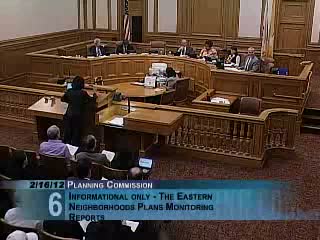
Planning Commission hears Eastern Neighborhoods monitoring report as commissioners press on PDR, jobs and open space
Summary
Staff presented five-year monitoring reports for the Eastern Neighborhoods area plans covering 2006'/2010; commissioners and public discussed PDR loss, job-housing balance, and possible code changes to improve implementation.
The Planning Commission on Feb. 16 received an informational monitoring report on the Eastern Neighborhoods area plans covering approximately 2006 through early 2010.
Senior planner Teresa Ojeda told commissioners the monitoring work examines trends in commercial and residential development, public benefits and implementation programs. Key findings: roughly 1.1 million net new commercial square feet in the period (about 18% of citywide nonresidential growth), nearly 2,900 net new housing units in the Eastern neighborhoods (about 23% of the city's production in that period), and a residential pipeline that is small relative to citywide pipeline but concentrated in several major projects (Candlestick, Treasure Island, Park Merced).
Ojeda said the pipeline shows significant conversion and loss of PDR (production, distribution, repair) space in some corridors, and estimated the new commercial development could accommodate roughly 2,600 new office and retail jobs. She noted roughly a quarter of the Eastern neighborhoods' new housing units were affordable, with 60% of those funded by public assistance.
Public commenters and developers raised implementation concerns. Developer Dan Murphy described a 3.3-acre Showplace Square parcel whose desired mixed-use, job-generating concept lacked a clear implementation tool in the code. Housing advocates and commissioners suggested modest code tweaks (relaxing certain ground-floor height rules, open-space metrics or dwelling-unit exposure ratios) to improve feasibility without undermining plan objectives. Commissioners noted trade-offs between preserving PDR and enabling new job-creating uses.
Commissioners asked staff to bring further analysis on several points, including how environmental-review budgets and programmatic resources would cover potential EIR needs for neighborhood plans. Staff said follow-up memos and future briefings would address outstanding questions.
"We took about half of the M-zone land and changed it to allow mixed use and the other half changed to PDR as a protection of PDR businesses," Director Ram said in response to commissioners' questions, cautioning that any change to PDR policy should follow robust community discussion. Commissioners agreed to continue scrutiny of PDR protections and possible code interpretations as implementation proceeds.