Get Full Government Meeting Transcripts, Videos, & Alerts Forever!
Get email alerts on the Transportation topic
No spam. Unsubscribe anytime.
Board upholds Van Ness BRT tree‑removal permit after marathon hearing
Summary
After hours of testimony from hundreds of residents, community groups and experts, the San Francisco Board of Appeals denied an appeal of a Public Works tree‑removal/planting permit tied to the Van Ness Bus Rapid Transit project and adopted environmental findings; judges said replacement planting and project approvals addressed impacts.
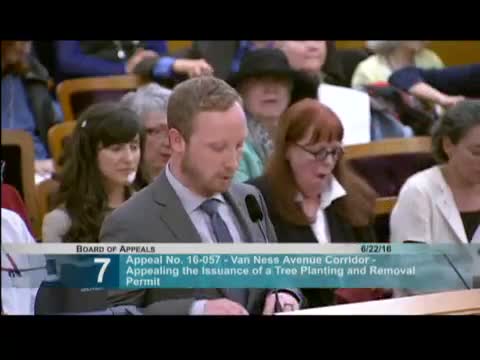
The Board of Appeals on June 22 denied an appeal of a Public Works tree‑removal and planting permit for the Van Ness Improvement Project, a center‑running Bus Rapid Transit (BRT) plan that requires reconfiguration of medians and sidewalks. The decision came after an evening of packed public comment and expert testimony for and against large‑scale tree removal along the U.S.‑101 Boulevard through San Francisco.
Project sponsors (San Francisco County Transportation Authority and SFMTA) described the BRT as a decades‑long initiative intended to speed and make bus travel more reliable along Van Ness; they said the selected alternative — which Caltrans and federal reviewers approved during the environmental review concluded in 2013 — requires median reconfiguration and removal of 86 median trees and 4 sidewalk trees, with planting of 210 replacement median trees and a 2:1 replacement policy.
Public Works and SFMTA staff explained a species‑selection process that invited expert panels, the Urban Forestry Council and the Arts Commission; the chosen median species was lemon‑scented gum (Corymbia citriodora) and the replacement trees are to be contract‑sized (about 36‑inch box) and planted at greater density to create a consistent future canopy. Opponents — neighborhood residents, tree advocates, scientists and some transit critics — urged the board to preserve the mature 50–60‑foot canopy and asked for less‑intrusive alternatives (curbside BRT, express buses) or phased approaches.
After debate over environmental review, tree‑protection law, canopy timing and construction sequencing, Commissioner Anne Lazarus moved to deny the appeal and uphold the permit along with adoption of environmental findings. The motion carried 3–1 with one absence. The board concluded the permit had been validly issued following public review, and that replacement plantings and construction sequencing were part of the approved mitigation package.
Why this matters: The Van Ness corridor is a major arterial and the board’s decision clears a major regulatory obstruction to a high‑profile, federally reviewed transit project. The decision does not remove all political controversy; opponents are likely to pursue additional forums and the project sponsors must now coordinate construction sequencing, funding and detailed mitigation to preserve long‑term canopy goals while building transit infrastructure.
Next steps: With the board’s decision the project team can proceed toward contract finalization and construction mobilization pending funding and final administrative steps; SFMTA and Public Works will oversee removal, replacements and monitoring per permit conditions.