Get Full Government Meeting Transcripts, Videos, & Alerts Forever!
Get email alerts on the Transportation topic
No spam. Unsubscribe anytime.
'Walk First' plan maps 44 miles of priority streets and estimates $600–$700 million to improve pedestrian safety
Summary
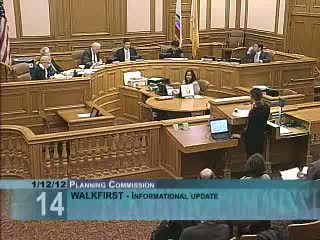
The Planning Department's Walk First study identifies high‑priority walking streets that account for a disproportionate share of severe and fatal pedestrian injuries and presents a capital list with cost estimates and suggested general‑plan map updates; staff urged phased implementation and highlighted new funding sources.
Planning Department staff presented Walk First, a year‑long pedestrian safety and prioritization project that mapped factors contributing to walking (transit access, pedestrian generators, vulnerable populations) and compared them with collision/injury data to identify high‑priority corridors. The plan's analysis shows about 44 miles of city streets that together account for more than half of severe and fatal pedestrian injuries; preliminary capital costs to implement recommended improvements are estimated at $600–$700 million.
The project's approach layered pedestrian activity indicators with high‑injury density corridors to define where engineering, enforcement, and education investments would have highest impact. Staff emphasized the list was preliminary, needs further outreach and CEQA, and offered typologies and case studies for different corridor contexts.
Commissioners and agency partners from the Department of Public Health and SFMTA discussed phased interventions — lower‑cost tactical projects such as sidewalk widening, curb bulb‑outs, or pavement‑to‑parks treatments in the short term and larger corridor rebuilds where warranted. New local funding (the November roadway bond/Prop B and vehicle fee Prop AA) provides matching opportunities for implementation. Staff proposed general‑plan amendments to map and prioritize key pedestrian streets.
What’s next: staff seeks funding to continue outreach and move the project toward CEQA and formal plan amendments; the Commission encouraged focusing on near‑term, low‑cost projects in priority corridors while building the capital case for larger investments.