Get Full Government Meeting Transcripts, Videos, & Alerts Forever!
Get email alerts on the Telecommunications topic
No spam. Unsubscribe anytime.
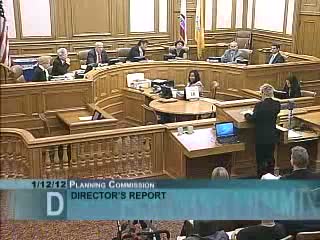
Planning Commission endorses independent RF review for wireless permits and approves two antenna sites
Summary
The Planning Commission voted to adopt a Board of Supervisors‑recommended condition requiring an independent, state‑licensed engineer to verify wireless carriers' coverage/capacity maps for pipeline wireless conditional uses and approved two roof‑mounted antenna installations with that condition attached.
The San Francisco Planning Commission on Jan. 12 voted to attach a new independent‑evaluator condition to wireless conditional use approvals and approved two carrier installations that will be subject to it.
The action responds to appeals the Board of Supervisors heard late last year about discrepancies between carrier coverage maps and evidence presented by local appellants. Planning staff summarized Board guidance that an independent consultant — a California‑licensed professional engineer acceptable to the Planning Department and bound by confidentiality with the carrier — should verify that a provider’s maps and claims about coverage gaps and capacity are accurate. If the evaluator finds the carrier’s data inaccurate, the conditional use would be disapproved; if accurate, the CU could be approved without further action.
Commissioners approved that condition as part of the package for Verizon’s proposed co‑located antennas at 1344 Ocean Avenue and AT&T’s proposed installation at 1408 California Street. Staff had concluded both projects complied with planning code standards and the Department of Public Health had reviewed RF reports finding compliance with FCC guidelines. At the Ocean Avenue hearing, Verizon’s engineer said the combined installations would produce RF levels well below public limits (reported in the packet as roughly 3–4 percent at the closest point), and the company described a coverage gap the installation would fill.
Neighbors had pressed concerns about cumulative exposures, notice and the visibility of antenna disguises. Commissioners and staff emphasized that the independent evaluator condition requires the wireless provider to bear the cost of evaluation, to fully cooperate with the evaluator, and gives Planning the ability to keep submitted proprietary data confidential under a signed agreement. The condition was read into the record by the zoning administrator and included in the motions to approve both permits.
The Commission’s votes were unanimous on both projects; during debate several commissioners urged the department to apply the evaluator requirement broadly to similar pipeline projects to create consistent checks and balances.
What’s next: The Planning Department will select independent evaluators for pipeline projects when required and monitor compliance and post‑installation testing and reporting to the Department of Public Health as required by code.