Get Full Government Meeting Transcripts, Videos, & Alerts Forever!
Get email alerts on the Americas Cup Feir topic
No spam. Unsubscribe anytime.
Planning commission certifies FEIR for America's Cup and cruise-terminal work after months of review
Summary
The San Francisco Planning Commission certified the final environmental impact report for AC34 and the James R. Herman Cruise Terminal, finding the EIR adequate while noting several significant, unavoidable impacts that will require mitigation and further agency approvals.
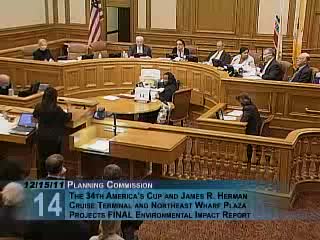
The San Francisco Planning Commission voted unanimously to certify the Final Environmental Impact Report for the 34th America’s Cup and related James R. Herman Cruise Terminal and Northeast Wharf Plaza projects, concluding a months-long environmental review and public-comment process.
Staff said the FEIR, together with published comment-response materials, incorporates refinements to race operations, utility and geotechnical assumptions, updated air-quality modeling and new mitigation language. It also adds a project-variant and a reduced-intensity alternative intended to limit long-term waterfront development rights.
Commission staffer Joy Navarrete told the commission that refined air-quality mitigation and operational changes reduce some emissions below Bay Area Air Quality Management District thresholds, but that emissions of reactive organic gases (ROG) and certain cumulative air-quality, transportation and noise impacts would remain significant and unavoidable. Those conclusions mean subsequent approvals by the Port Commission and Board of Supervisors would need statements of overriding considerations if those bodies approve the projects.
Supporters and opponents who addressed the commission urged rapid certification for different reasons. Proponents including tourism, labor and maritime groups highlighted anticipated economic activity and long-term waterfront investment. Environmental organizations and park managers praised strengthened mitigation measures while urging continued, specific funding commitments for park protection and long-term monitoring. The Port’s director and event sponsors said they would continue to refine implementation plans and to work with regulatory partners on mitigation and monitoring.
"We are committed to continued engagement with regulators and community stakeholders to implement the mitigation and monitoring program," Mike Martin of the Office of Economic and Workforce Development said during the staff presentation.
Commissioners emphasized that certifying the FEIR is a CEQA determination, not project approval; the Port Commission and other agencies must still consider permits and findings that flow from the environmental document. Commissioner comments noted the compressed timetable and cross‑agency coordination required to implement mitigation measures and to resolve remaining open questions about park restoration funding and neighborhood impacts.
The commission’s certification clears the way for the port and the Board of Supervisors to consider project approvals and related permits, while leaving in place mitigation, monitoring and reporting obligations described in the FEIR. The port, event authority and several city departments will continue work on implementation plans and permit conditions in the months ahead.