Get Full Government Meeting Transcripts, Videos, & Alerts Forever!
Get email alerts on the Public Art Policy topic
No spam. Unsubscribe anytime.
Planning Commission backs staff changes to 1% for art ordinance and recommends broader outreach to sponsors
Summary
The commission voted unanimously to approve Planning Department recommendations on the public art trust/1% for art ordinance — preserving the downtown gallery for large POPOs, allowing developer choice for other projects to provide on-site art or pay into a trust, removing an Arts Commission secondary review, and urging sponsors to consider expanding the requirement to other downtown districts after outreach.
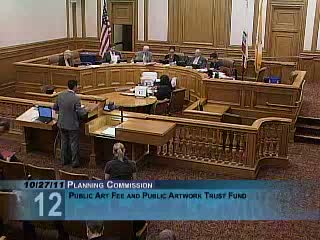
On Oct. 27 the San Francisco Planning Commission approved, by unanimous vote, a set of staff-recommended amendments to the city’s downtown '1% for art' requirement and asked legislative sponsors to consider further outreach about expanding applicability.
Planning staff recommended maintaining the on-site monumental art requirement for large privately owned publicly accessible open spaces (POPOs) visible at street level, while giving developers of other projects the choice to either provide on-site art or contribute to a public art trust fund administered through the Arts Commission. For very large projects, staff recommended requiring the first $1,000,000 of required art be provided on-site, with flexibility for amounts above that. Staff also advised removing a proposed requirement for a secondary Arts Commission review of private on-site pieces, contending that the existing public process and planning review provided adequate oversight.
Representatives of the mayor’s office and Board President David Chiu (via staff) signaled support for many staff recommendations but said further conversation is warranted on some details, notably geographic expansion of the requirement beyond the C3 downtown district. Arts-sector witnesses — including the Arts Commission, artists’ groups and advocacy organizations — largely supported the idea of a trust (to fund temporary art, preservation and citywide cultural facilities), but urged retention of strong curatorial oversight and a clear nexus for where off-site funds can be spent.
Developers and attorneys cautioned that allowing payment to a fund could reduce the amount of on-site art and that additional administrative review could deter on-site contributions. The commission adopted staff recommendations and included a resolution asking legislative sponsors to consider a citywide expansion (subject to outreach and refinements).