Get Full Government Meeting Transcripts, Videos, & Alerts Forever!
Get email alerts on the Wireless Permits topic
No spam. Unsubscribe anytime.
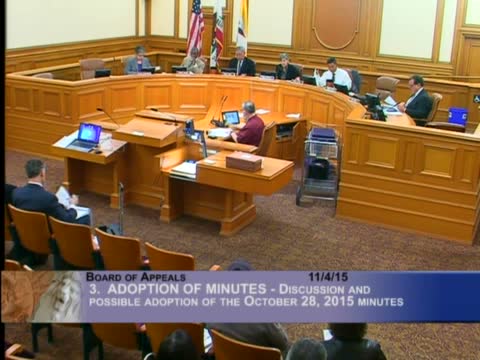
Board of Appeals rejects rehearing bids from wireless carriers amid Article 25 dispute
Summary
The San Francisco Board of Appeals on Nov. 4 denied multiple rehearing requests from Crown Castle/NextG permit holders who sought to overturn appeals that had revoked personal wireless facility permits over alleged defective notice under Article 25; Public Works said it will clarify notice rules in its departmental order.
The San Francisco Board of Appeals on Nov. 4 rejected rehearing requests from permit holders seeking to undo earlier revocations of personal wireless facility permits, largely over a dispute about how Article 25’s notice requirement applies to pole-mounted equipment.
Attorney Martin Feinman, representing the permit holder (identified in filings as Crown Castle NG West LLC), asked the board to grant rehearing in several appeals and argued that the code’s 150-foot noticing requirement applies to poles containing antennas, not to separate poles that support battery backup equipment. Feinman said applying a newly proposed Department of Public Works interpretation retroactively would be a "manifest injustice" to carriers that obtained permits under the department’s longstanding practice.
Appellants and public speakers told the board the ordinance language is unambiguous and that the notice should cover related facilities within 150 feet. John Birmingham and Jordan Kantor, among others, said mailing lists and on-pole postings lacked required photo simulations and sketches, and that neighbors were not consistently notified. Commenters raised safety, aesthetics and cumulative-impact concerns as reasons the Board’s earlier revocations should stand.
Public Works staff told the Board they support rehearing requests in the cases under consideration and that their department is preparing amendments to its internal order to clarify the notice process going forward. DPW staff said the department believes some provisions were ambiguous as applied to battery backup equipment but that they are moving to make the guidance explicit in a forthcoming departmental order.
Board members framed the dispute as largely legal and procedural: whether the notice deficiency identified at the prior hearing met the narrow standards for granting rehearing (new material facts or manifest injustice). Several commissioners said the threshold for rehearing is steep and that the permit holders had not shown the required new facts. On each contested rehearing the Board recorded motions to deny and the motions carried, leaving the prior revocations intact.
The Board did not adopt new policy at the meeting; DPW’s planned amendment to its departmental order was the primary forward-looking development. Where the record showed differences between the tentative and final permit conditions, DPW said it would "sync up" the language to avoid future disputes.
The Board moved on to other items after denying the rehearing requests.