Get Full Government Meeting Transcripts, Videos, & Alerts Forever!
Get email alerts on the Western Soma Community Plan topic
No spam. Unsubscribe anytime.
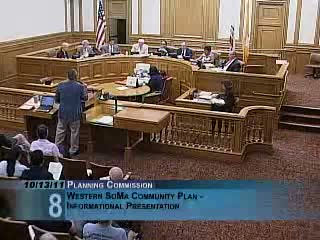
Planning commission hears Western SoMa community plan update and social heritage district proposals
Summary
Planners and community task-force representatives presented the Western SoMa Community Plan update, including proposed Filipino and LGBTQ social heritage districts, design guidelines and a community stabilization policy targeting a mixed-income neighborhood and an estimated 3,000–4,000 new units over 20 years.
Planners and community representatives told the Planning Commission an informational session on the Western SoMa Community Plan that the draft aims to preserve neighborhood character while guiding significant new housing, jobs and cultural protections. Paul Lord, senior planner, said staff will bring individual components forward for adoption following certification of an environmental impact report expected next year.
The presentation emphasized social heritage districts to preserve the histories and ongoing uses of specific communities. Bernadette Sai of the Filipino American Development Foundation described efforts to document Filipino cultural assets and to seek community-challenge grants for streetscape treatments on Minna and Natoma Streets. "Our work together with San Francisco planning also continues as we jointly prepare to get a community challenge grant for appropriate social heritage treatments integrated into the new designs from the County Transportation Authority," she told the commission. Gail Rubin, a scholar of LGBTQ history, outlined South of Market’s role as a national center for gay and leather culture from the 1960s through the 1980s and argued that preservation efforts must address “usage, information and memory,” not only buildings.
Staff described technical and zoning changes included in the plan: split zoning on very large sites that would trigger conditional-use review for height above the base limit, new mixed-use district types tailored to Western SoMa, protections and flexible buffers for entertainment uses, and an emphasis on arts and light-industrial (PDR) uses in certain districts. Jim Meeko, chair of the task force, described the community-stabilization policy that recommends minimum affordable housing expectations; staff and task-force materials cited past delivery of 707 affordable units out of 1,862 units (about 38%) since the 1990 rezoning and proposed a 30% target for new development in the plan area.
Commissioners and public speakers praised the extensive community engagement while asking for clearer boundaries and more detail on transit, enforcement of historic-survey findings and how the plan would treat entertainment and nonconforming uses. Several neighborhood speakers urged stronger protections for venues and for mechanisms to allow nonconforming entertainment uses to transfer to new buildings. Commissioner discussion focused on refining affordability targets, clarifying where entertainment uses would be allowed, and ensuring that preservation surveys reflect diverse viewpoints.
The commission did not take action; staff said the next steps include the draft EIR and subsequent adoption hearings. Commissioners asked staff to return with clearer maps comparing new districts to existing Eastern Neighborhood controls.