Get Full Government Meeting Transcripts, Videos, & Alerts Forever!
Get email alerts on the Market Octavia Inclusionary topic
No spam. Unsubscribe anytime.
Commission backs Market/Octavia inclusionary land‑dedication option, asks supervisors to review 40% threshold
Summary
Planning staff and housing officials described a Market/Octavia code amendment that would allow developers to satisfy inclusionary obligations by dedicating nearby land for affordable housing; the Commission approved the measure and asked that the 40% land/unit threshold be reviewed.
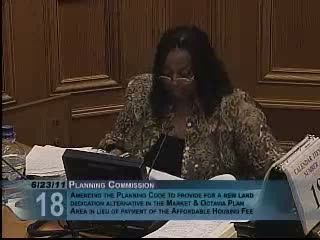
The Planning Commission on June 23 reviewed a proposed planning-code amendment to add a land-dedication alternative for inclusionary housing in the Market/Octavia plan area.
Kirsten Lissinger (Planning) explained the measure: a principal project in the plan area could dedicate a site within a specified radius (half‑mile inside the plan area, quarter‑mile outside) for affordable development rather than provide inclusionary units on-site or pay the fee. Under the draft language cited at the hearing, a dedication would aim to yield roughly 40% of the development capacity as affordable units on the dedicated parcel; staff said the higher percentage reflects that the sponsor is only providing land rather than units.
Lissinger summarized program mechanics: the mayor's office of housing would review and certify any dedicated parcel for feasibility and affordability standards; the Planning Commission would have 90 days to approve or deny a proposed land-dedication arrangement. Shandra Egan (Mayor's Office of Housing) and CAC representatives said the approach is intended as a limited alternative when on-site mixed-income units are impractical.
Commissioners raised questions about feasibility, site size, construction types and whether the 40% threshold unduly encourages feeing-out of on‑site units. The Commission approved the initiative with a recommendation that the Board of Supervisors review and consider adjustments to the 40%/lot-size threshold; the motion passed unanimously.
Quote from staff: "If you provide the inclusionary units on your site, you provide 15%. If you provide off‑site, you provide 20%." (staff explanation of existing options during the meeting.)
Next steps: the Commission transmitted its recommendations; staff and the mayor's office will continue technical review and a five‑year financial feasibility study of the inclusionary program is scheduled this fall.