Get Full Government Meeting Transcripts, Videos, & Alerts Forever!
Get email alerts on the Outdoor Seating Noise topic
No spam. Unsubscribe anytime.
Board of Appeals Upholds La Urbana Sidewalk Seating Permit With Six-Month Trial and Noise Conditions
Summary
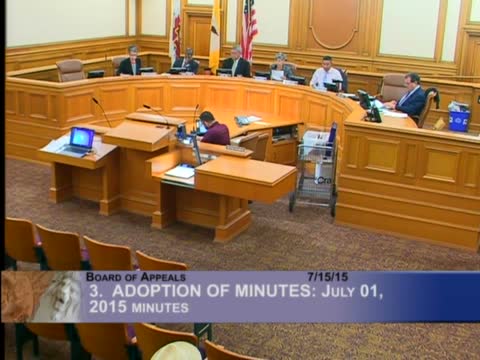
The San Francisco Board of Appeals on July 15, 2015 upheld a Department of Public Works permit for 10 tables/20 chairs at 661 Divisadero/Grove (La Urbana) but attached conditions including a six-month expiration and a requirement that garage doors close at 9:30 p.m. amid neighborhood noise complaints.
The San Francisco Board of Appeals on July 15 upheld a DPW-issued tables-and-chairs permit for La Urbana at 661 Divisadero/Grove while adding conditions intended to limit late-night noise and give the neighborhood a trial period. The board voted 4–1 to adopt DPW’s permit with a six-month expiration and a requirement that the restaurant’s garage doors close at 9:30 p.m.
Neighbors and a neighborhood group argued the permit process and the restaurant’s behavior had produced a persistent noise problem. Michael Cupitz, who said he runs the Grove Residents Rights Resource, told the board that the public notice was posted in a recessed foyer where opposing neighbors could not see it and that DPW’s adjustment to hours was an insufficient ‘‘compromise’’ because it left the core intrusion in place. "We have endured...the mounting food‑courtization of the streets under our bedroom windows," Cupitz said during his presentation.
La Urbana representatives and their architect said the seating plan reflects long-standing efforts to activate the commercial corridor and that they had made concessions, including reduced hours and seating. Eduardo Rayo, identified as an owner, said the restaurant had collected supporters and that staff respond to complaints: "We follow the rules ... when there's anything that seems in excess ... we addressed it immediately." Manager Rodrigo Lopez said staff close the garage doors and try to quiet patrons when complaints arise.
Carla Short of the Department of Public Works told the board DPW inspected the site and measured sidewalk grades; DPW concluded that the slope differences were not so substantial as to prevent access and that moving seating toward Divisadero better connected to the commercial corridor. Short said DPW would track 311 complaints related to the permit and consider that record during renewal.
Commissioners pressed both sides on enforcement mechanics and on whether closing the garage doors would sufficiently reduce noise. Several neighbors described repeated late-night noise, alcohol-fueled crowds at televised sporting events, and alleged past failures to comply with permit terms. Appellants said they had video evidence of doors left open after midnight and described difficulties obtaining consistent police enforcement.
After extensive questioning and a failed motion to revoke the permit, Commissioner Rick Swig moved to uphold DPW’s permit with conditions: limit seating to DPW‑approved locations and counts (the existing approval for 10 tables/20 chairs), require garage doors to be closed at 9:30 p.m., and set the permit to expire in six months so DPW could reassess. That motion passed 4–1. The board recorded the action as an upholding of the permit with those conditions.
The board’s action means the permit will remain in effect under the new conditions; DPW will monitor complaints through 311 and the permit holder will need to demonstrate compliance before renewal. The matter concluded with the board noting the decision reflected a compromise between supporting small-business activation of public space and addressing neighborhood disturbance.